

Saboun
The further life of olives

Happy new year to all my readers! Thank you for being here, and a particular thanks to everyone who found this publication worth supporting with cash. I won’t pretend the year didn’t start ominously, but as ever we can only hope, and hold on to what is worth saving.
I write this issue from Beirut, where I came to visit family and found myself with enough material for this impromptu feature. Photos are mine except where specified, in which case they are my mother’s1.
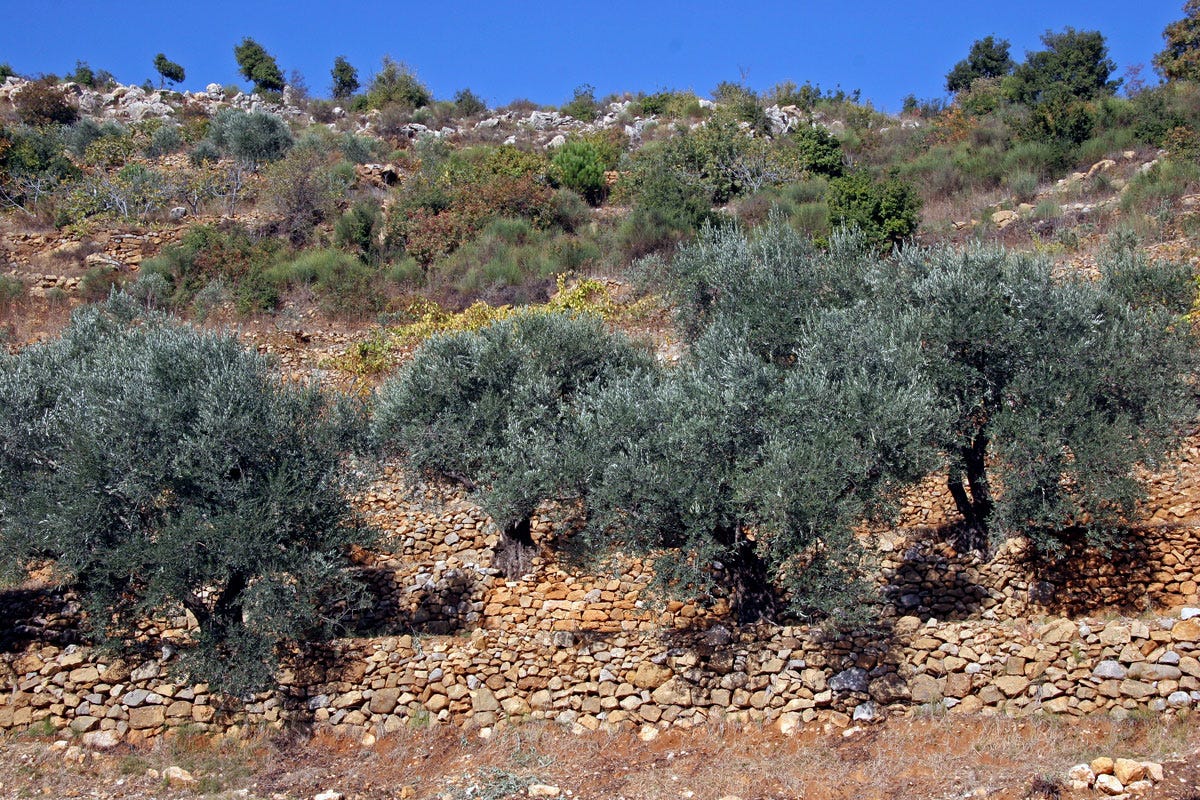
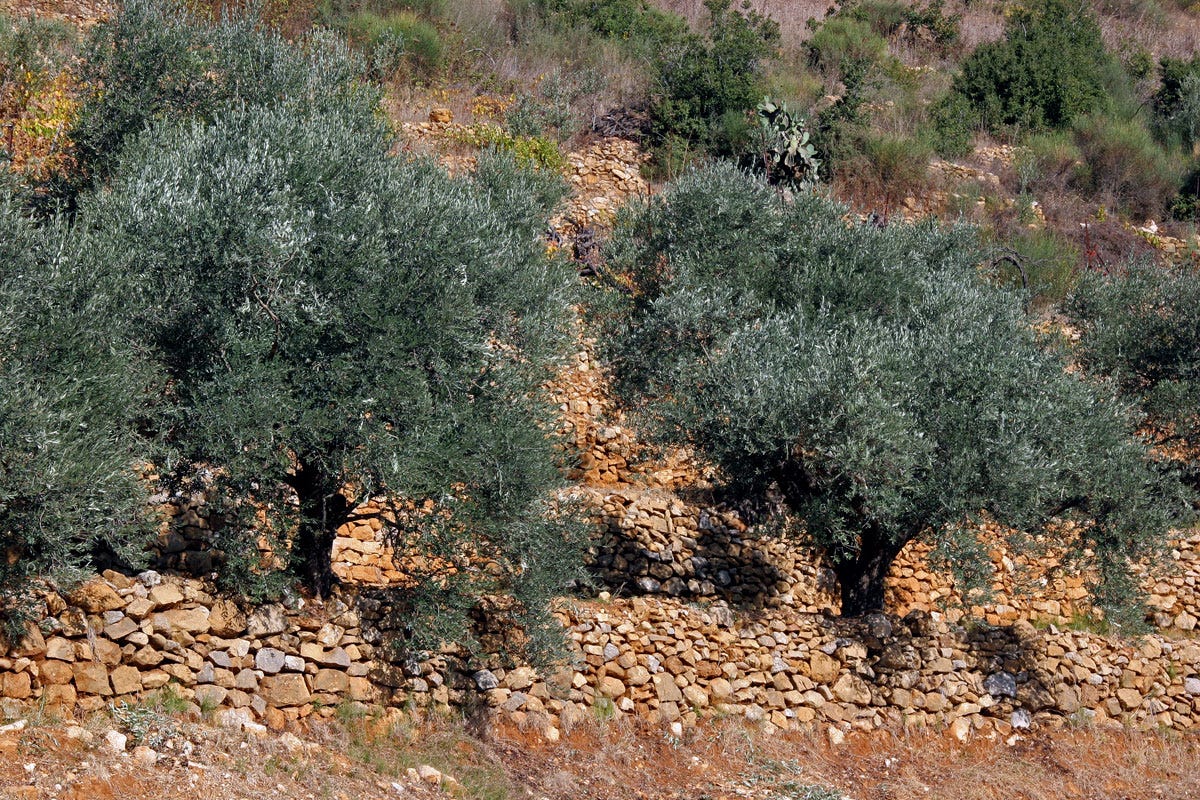
One of the oldest fruit trees to be domesticated, the olive was first cultivated in the Levant. To this day it is at the heart of societies in this part of the world, and where it has migrated around the Mediterranean.
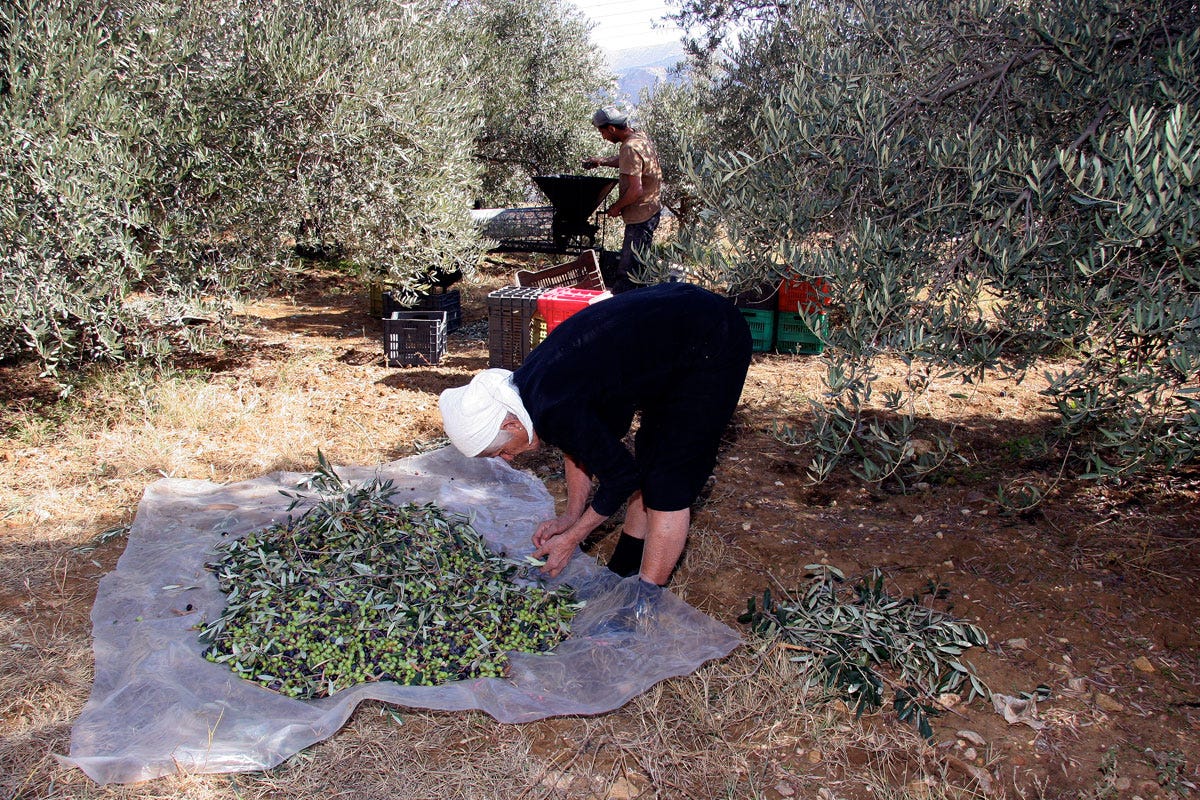
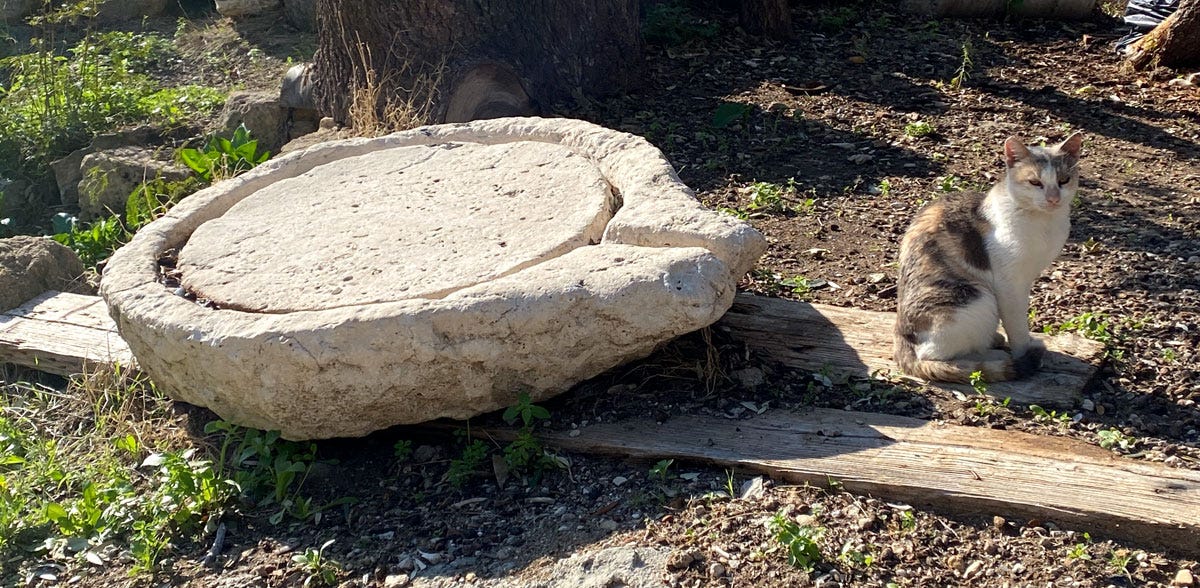
But in the Levant, it’s not just about the olives and olive oil for the table, or even the fact the oil serves to preserve many foods without refrigeration: the olive fed an entire lifestyle, a social ecosystem built around… soap.
Some olives, such as those that fall off the tree prematurely, are not suitable for consumption, but no product of the precious olive tree is lost: these “waste” olives are pressed, and their oil used as the base ingredient in soapmaking.
Soap has existed in one form or another for thousands of years. In the Middle East, pleasant-smelling hard soaps – in other words the form we’re familiar with today2 –were already being made in Abbasid times. We have soapmaking recipes from that period, described by the tenth-century physician and polymath al-Razi3. In Europe, animal fat was used – resulting in malodorous soap – until the hard olive oil-based bars of the Levant were introduced. Though the European soap production then shifted to olive-producing countries such as Italy and Spain, it remained a luxury product until early modern times.
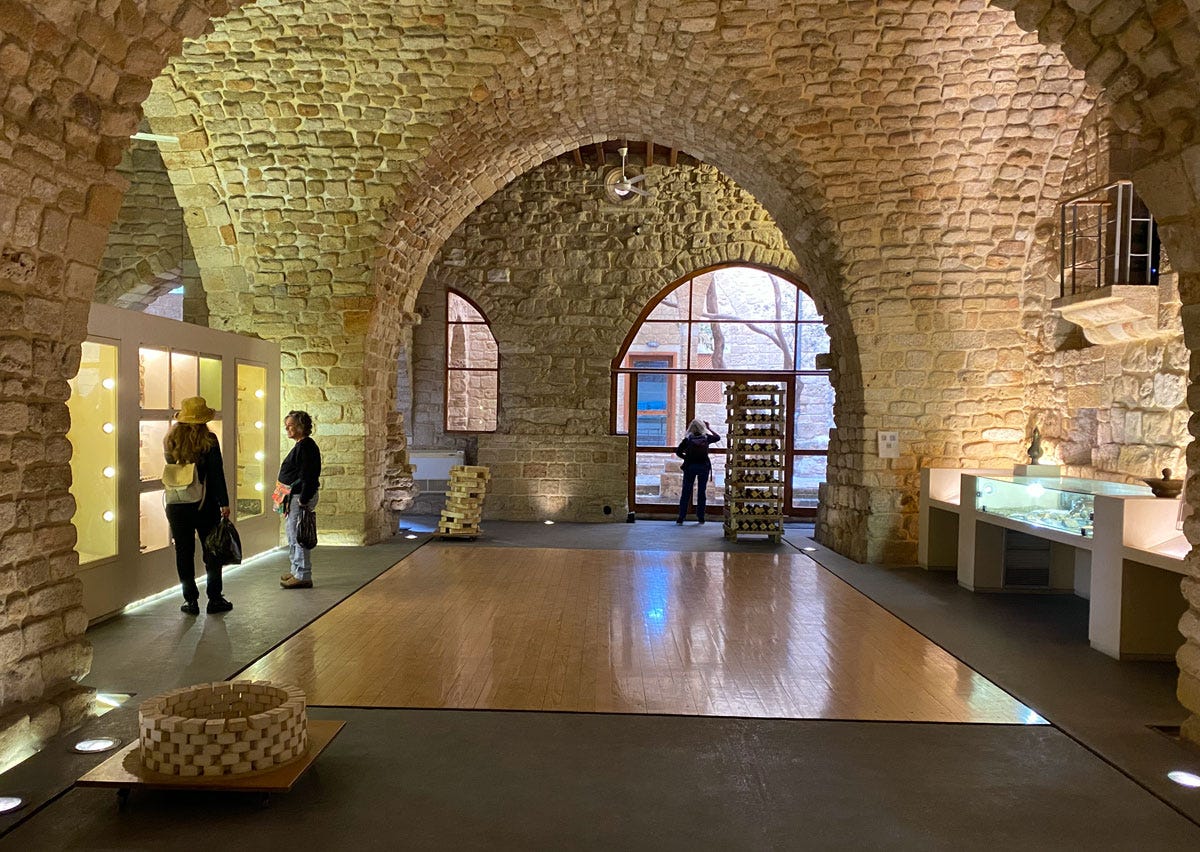
In Lebanon, where all things modern were embraced when the Ottoman Empire crumbled and lost its grip on the region, traditional soapmaking declined and nearly vanished. But in the wake of the civil war, reconstruction brought to light and revived this practice to such a degree it’s now flourishing again. Soapmaking families are active again in the cities of Tripoli and Sidon, and one Sidon workshop, originally built in the seventeenth century, has been made into a Soap Museum by the Audi Foundation, whose family owned the house before the civil war forced them to abandon it for a number of years. The display photos shared below are from the Museum.
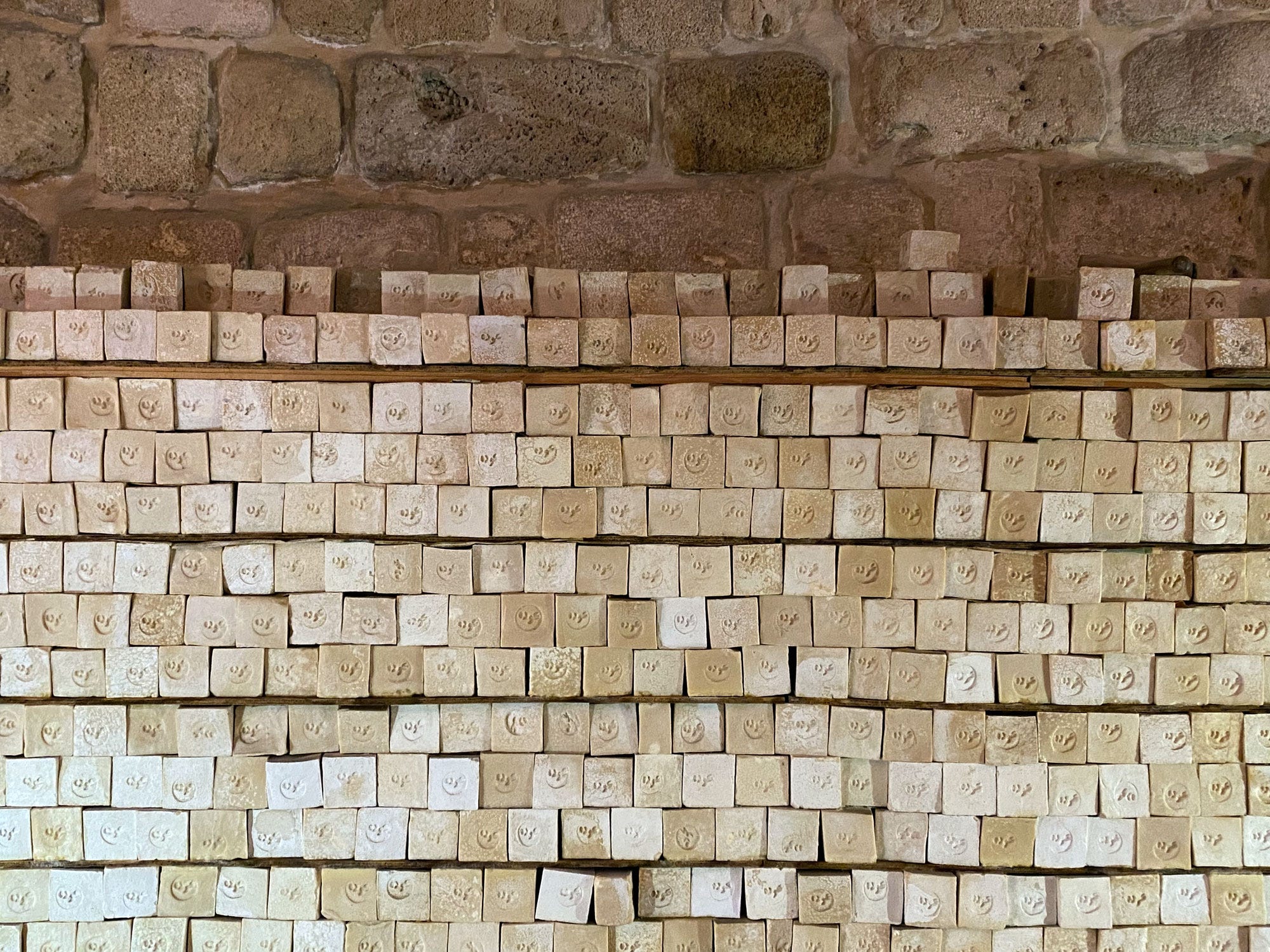
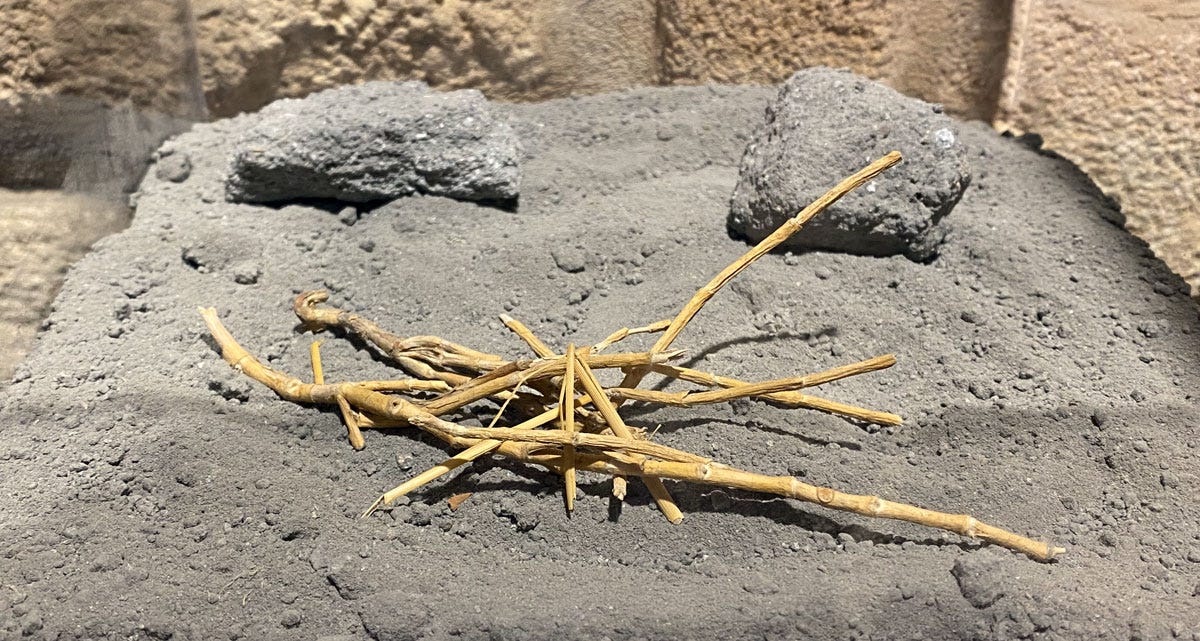
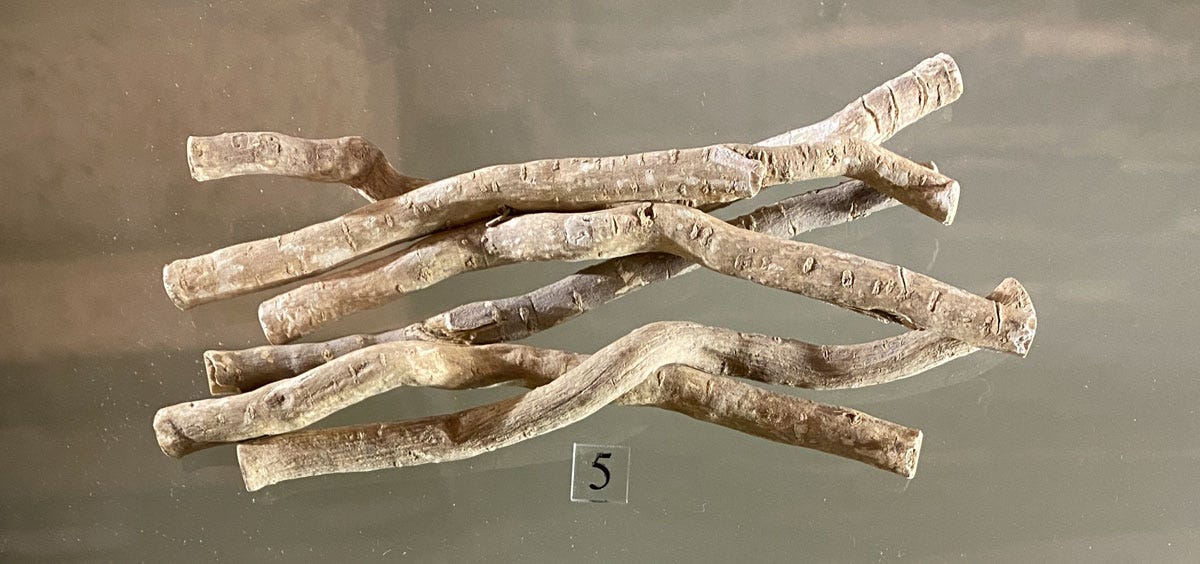
Aside from a fatty substance, which is here olive oil, the key ingredient in soapmaking is an alkali. This word also goes back to Al-Razi’s days and comes from arabic القليّ al-qily. This is soda ash, the ashes of Salsola kali (saltwort), a plant indigenous to the Syro-Jordanian steppe. The early appearance of soap production in the Levant, was not only due to the presence of olives, but also to the proximity of this plant’s habitat.
The process of making soap begins by mixing these ashes with lime and water in the fermentation pits you see below (top row). The resulting caustic solution is filtered into the lower basins, then returned to the fermentation pits, and so on, for a couple of days until this step is complete.
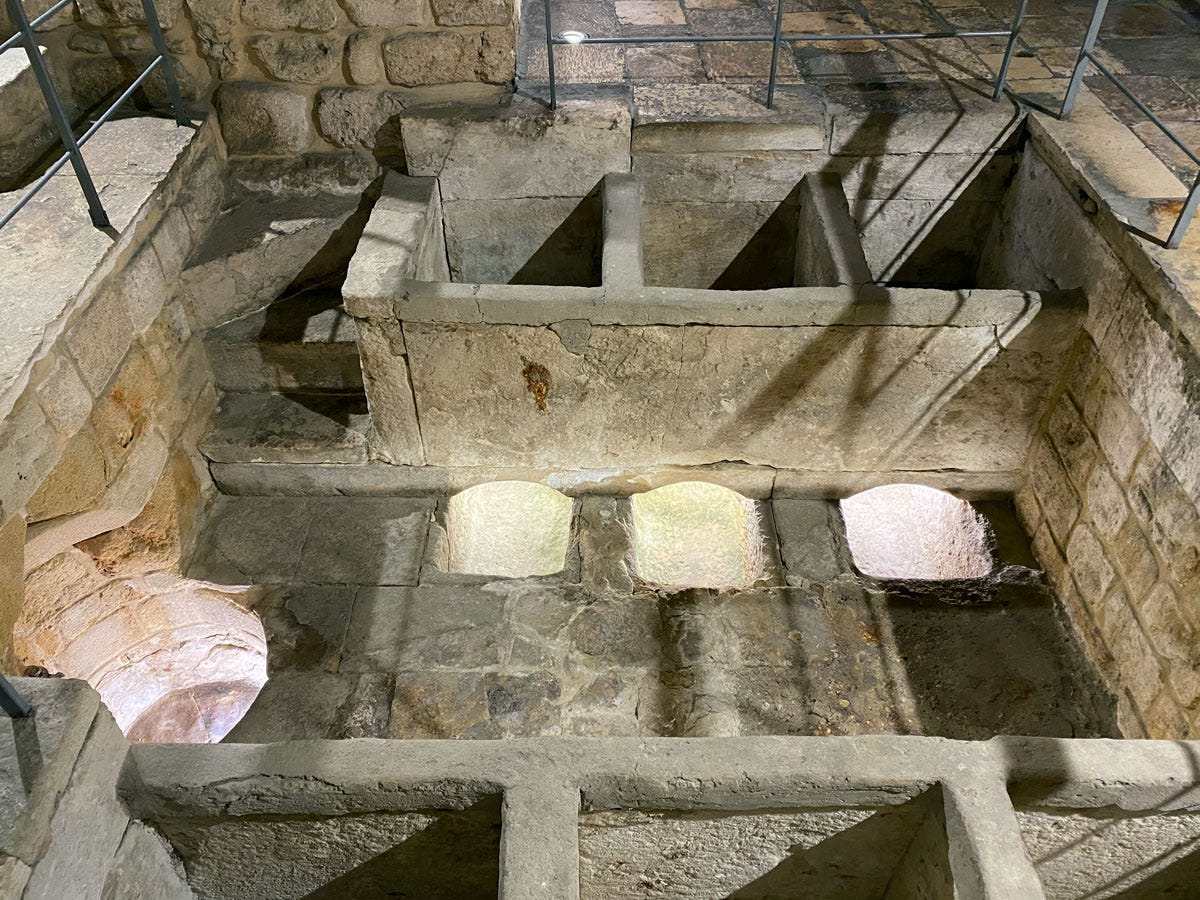
The pit below is a vat in which the olive oil is heated before the caustic water is mixed with it. There are rough-hewn steps along the side leading down to a narrow space from which one can feed fuel into the mouth of a furnace located righ tunder the vat. Before the introduction of gas, this fuel often consisted of more “waste” products from the olive: wood, olive pits, residues of olive pulp, or charcoal made from olive pits.
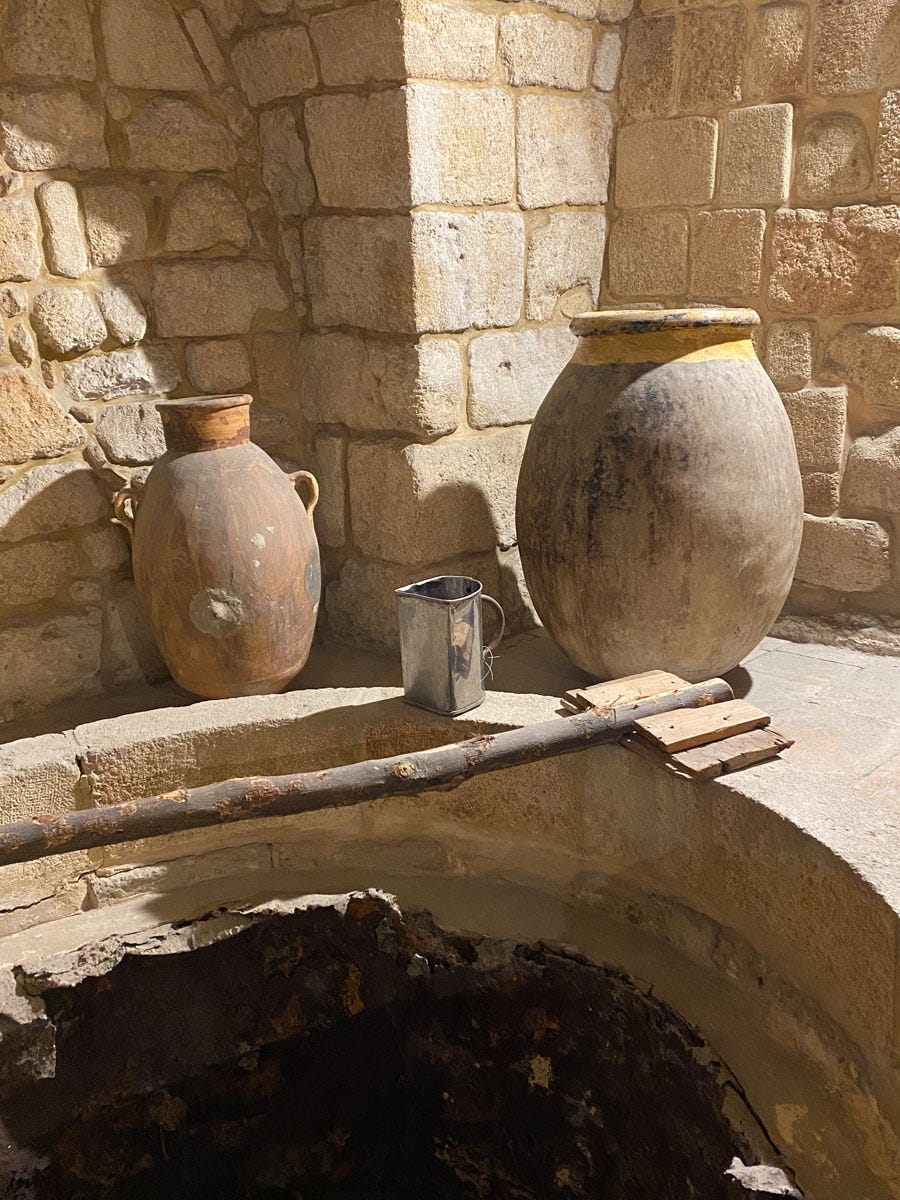
The mixture is heated and stirred for five days until the oil is completely absorbed by the caustic waters; the soap maker determined the saponification4 was completed by tasting the paste!
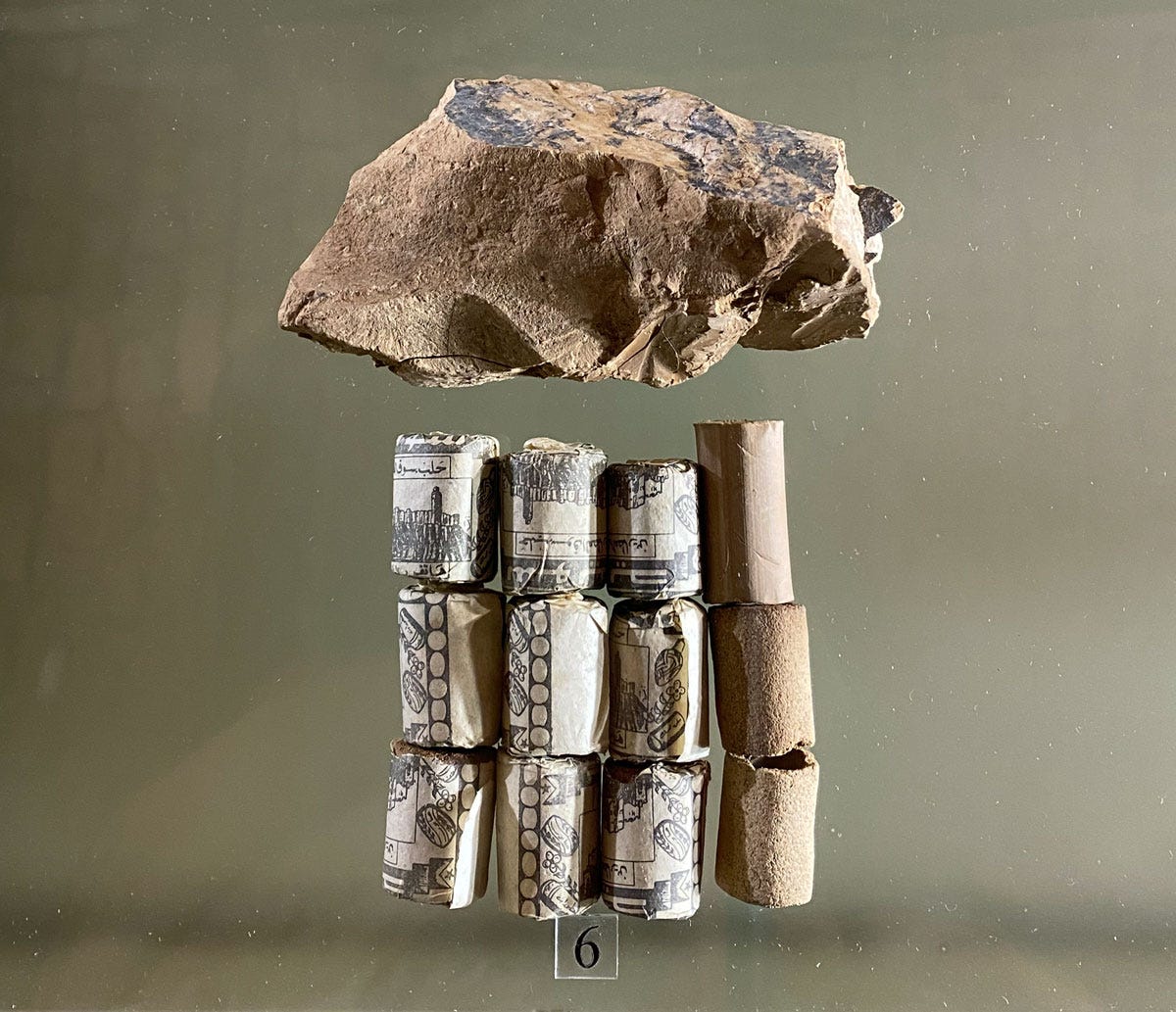
All sorts of essential oils can be added to soap to give it a fragrance and/or special qualities. Laurel oil غار is probably the most traditional of them all, and has both antiseptic and hydrating qualities. Storax balsam5 ميعة is another, mostly used for its aroma. But the list is long, and personal favourites include lily, jasmine and gardenia.


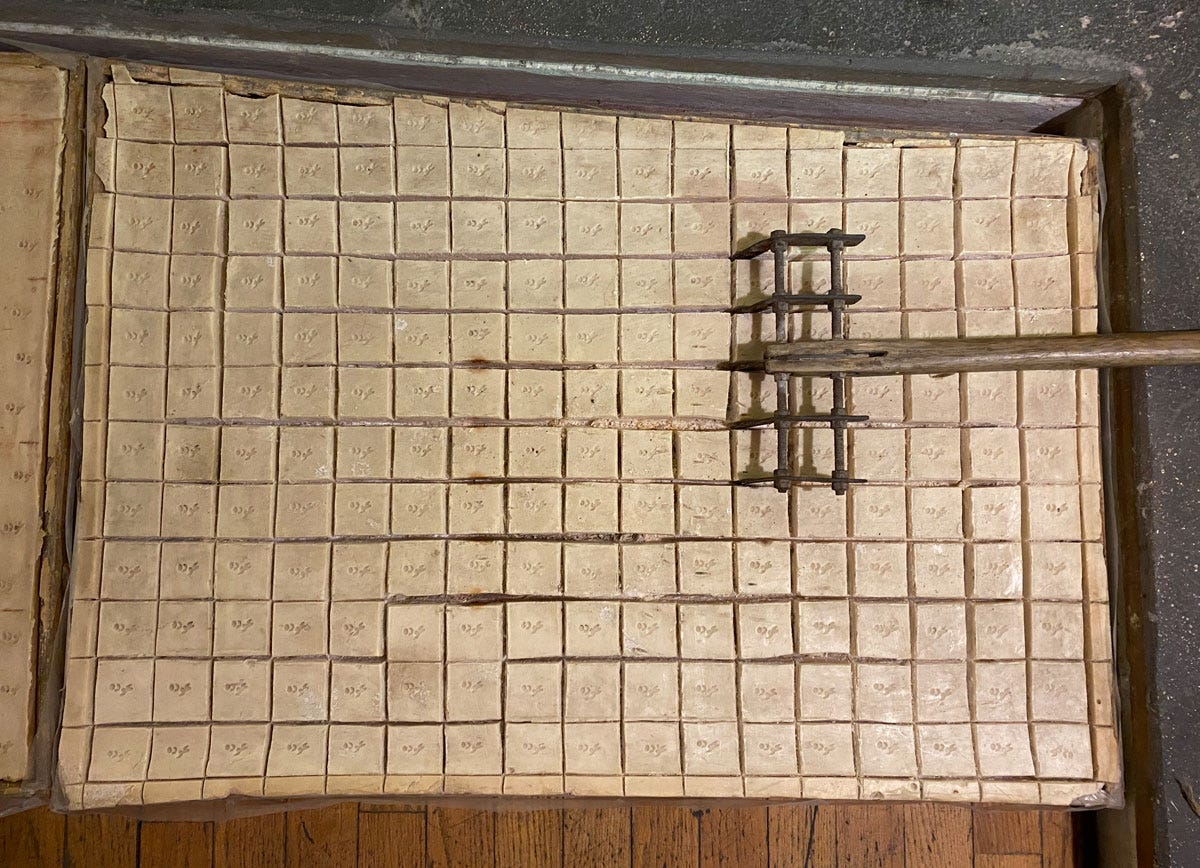
The completed soap paste is taken in buckets to the cutting area or mafrash, a stone floor that is depressed or simply framed with wood. The paste is poured into it and leveled with a spatula-like implement called malej. A day later, it’s marked with a grid using an ingenious method: a string soaked in red dye is pulled and released so it whips against the soapy surface. The giant T-square is used as a guide.
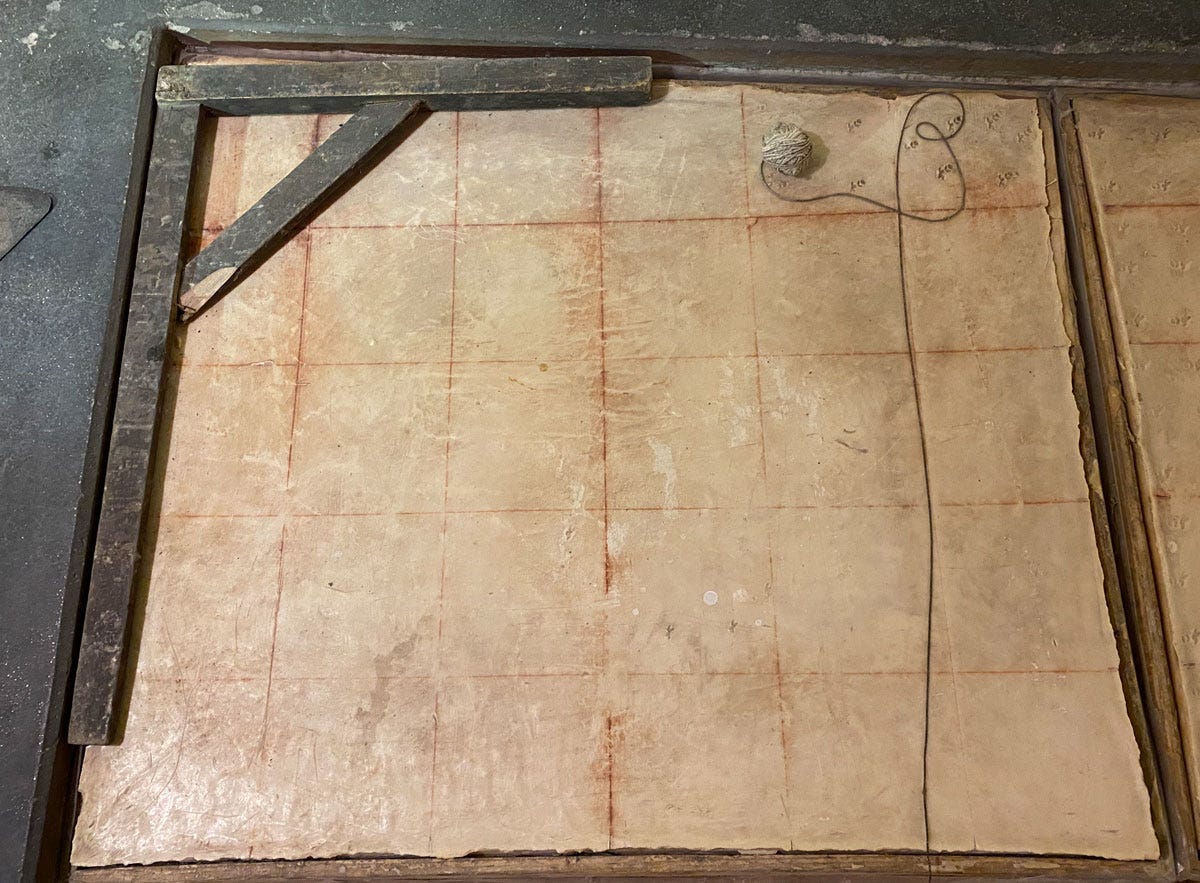
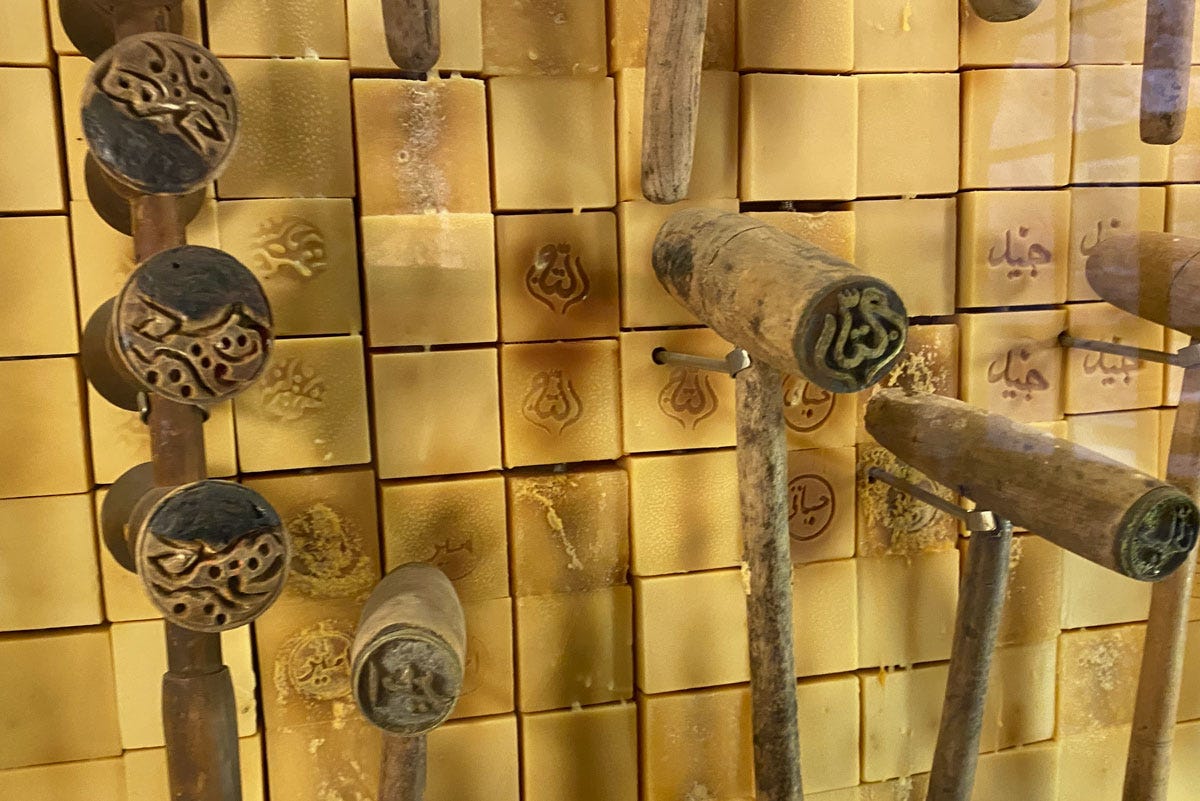
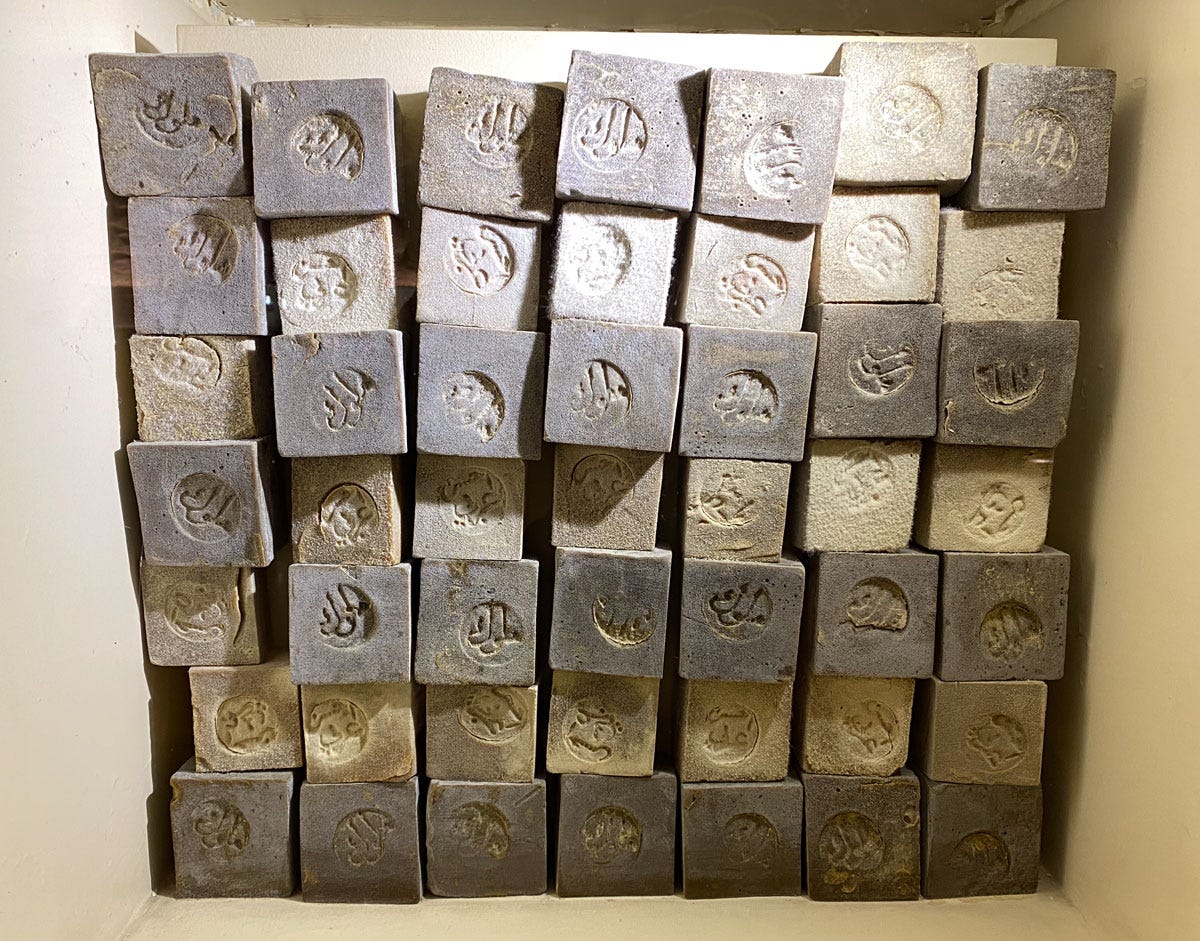
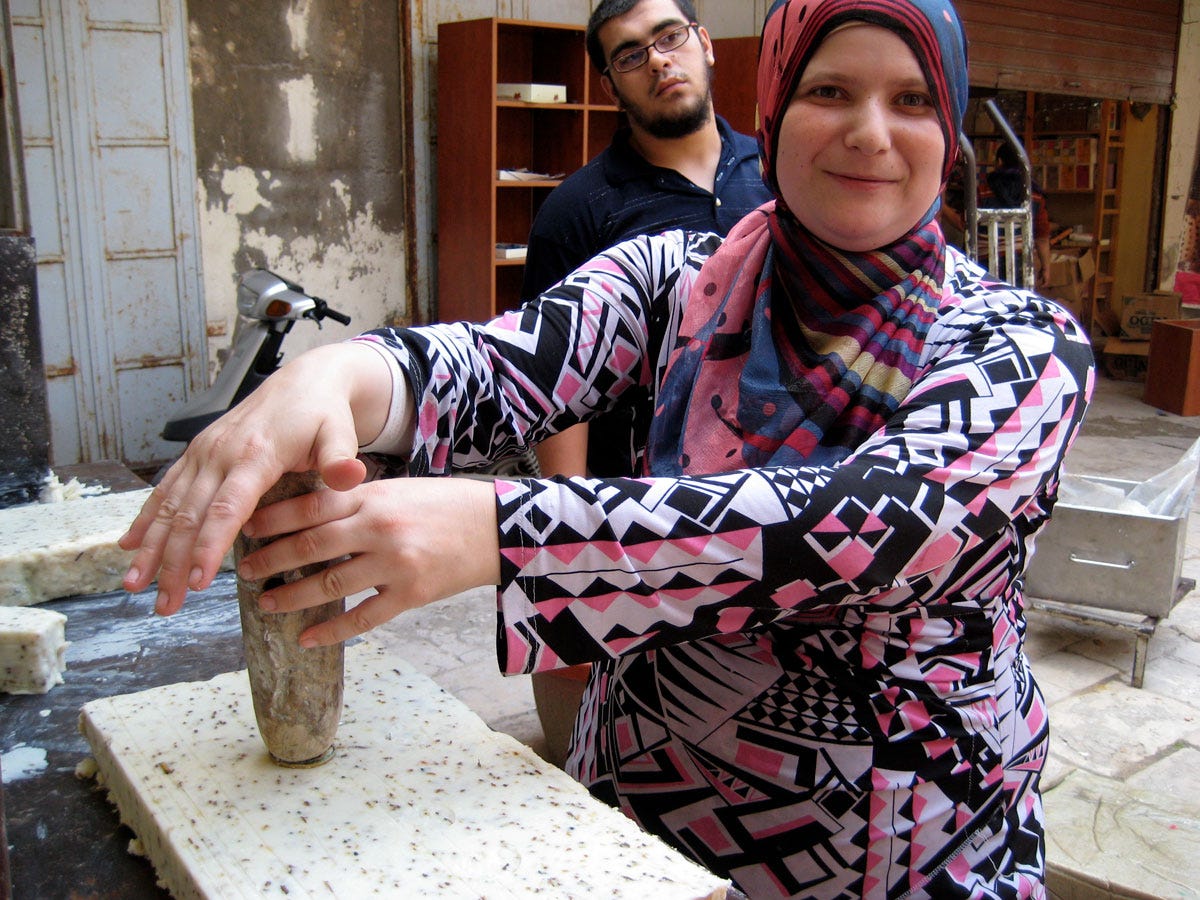
The next step is stamping the soap with the maker’s mark, using a small mallet affixed with a metal stamp. The point of the grid is to help place the stamps correctly, and this step could be done by children.
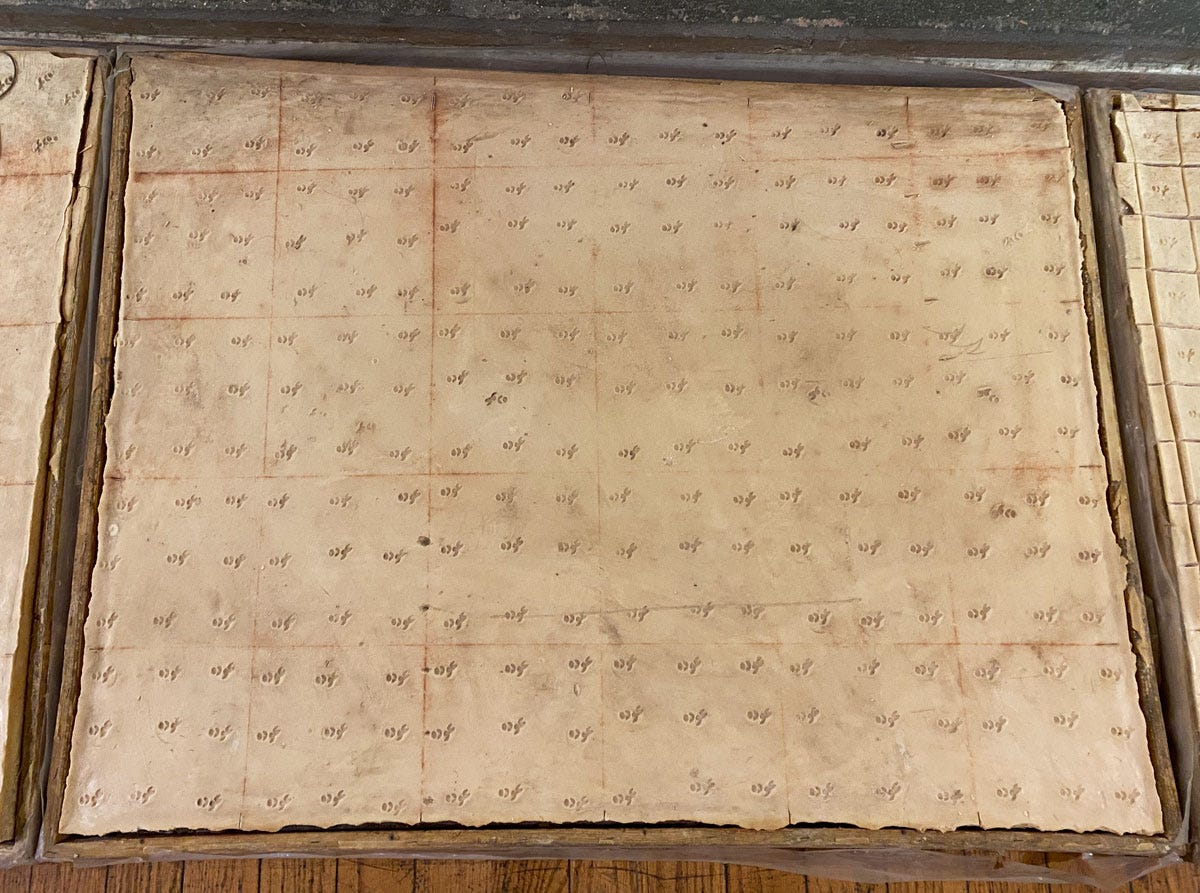
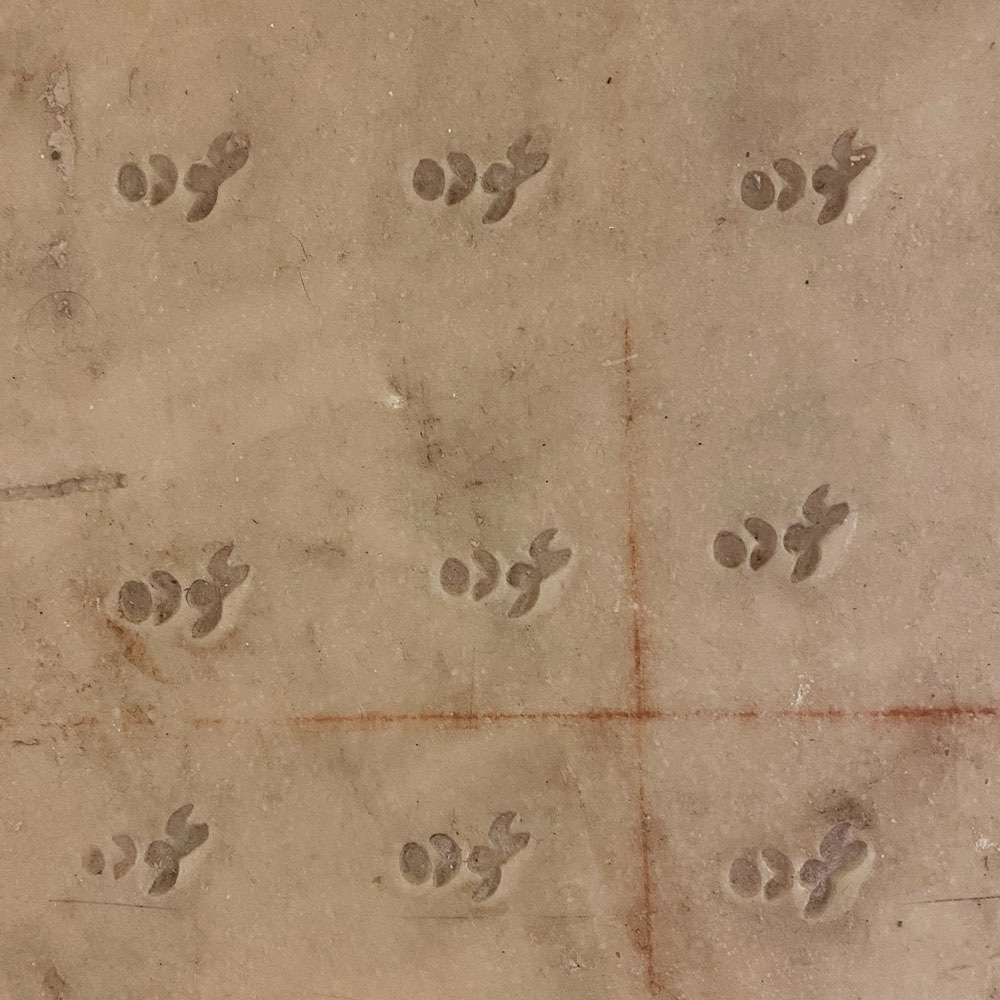
In this display, the stamp at the far left seems to have been designed to save time, as it has four stamp heads!
When the soap is firm, but still soft enough for easy cutting, a multi-bladed knife is pulled across the surface to cut the grid into small squares, often with a child sitting on it for added weight.
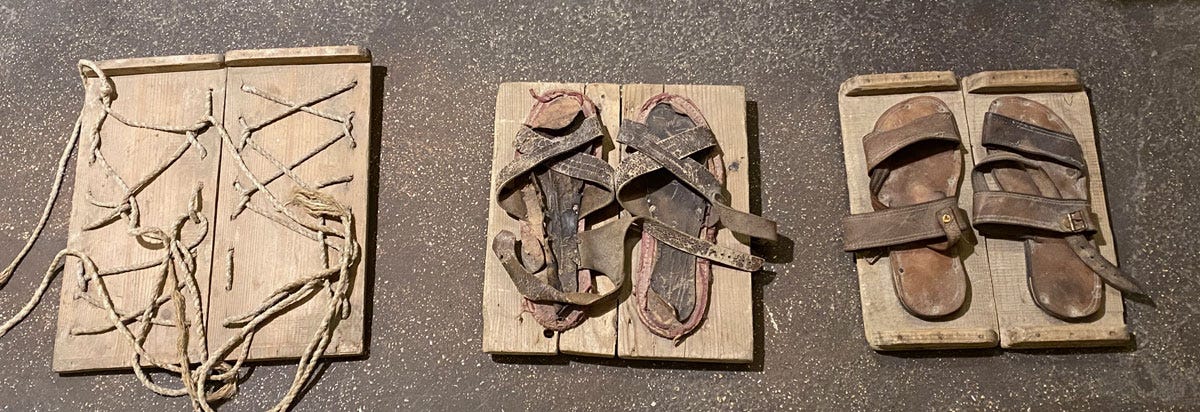
By the way, for any task that requires stepping on the still-soft soap, workers use these special clogs to preserve the surface.
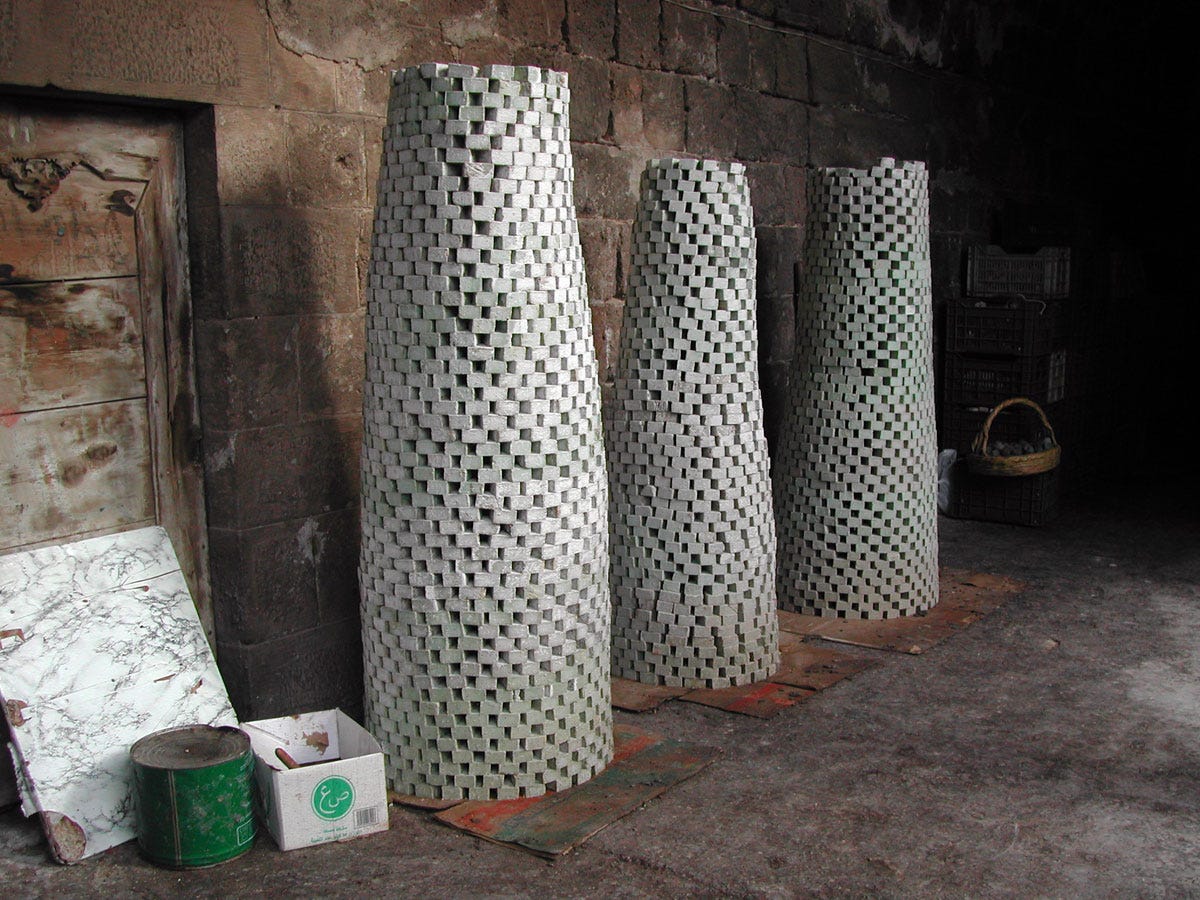
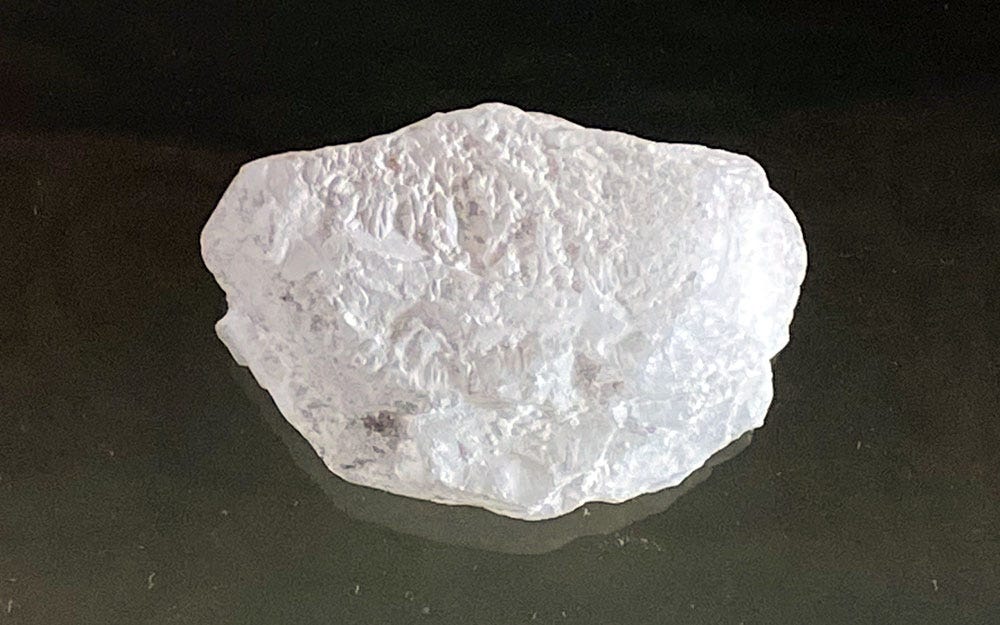
The soap must now cure. This stops it falling apart when used, but more importantly it eliminates the irritating effect of the caustic agents it contains. The longer it’s allowed to dry, the better the resulting quality. It can lose up to a third of its weight in the process, but this makes it much harder to dissolve, unlike poorly cured handmade soaps which melt away in a matter of days.
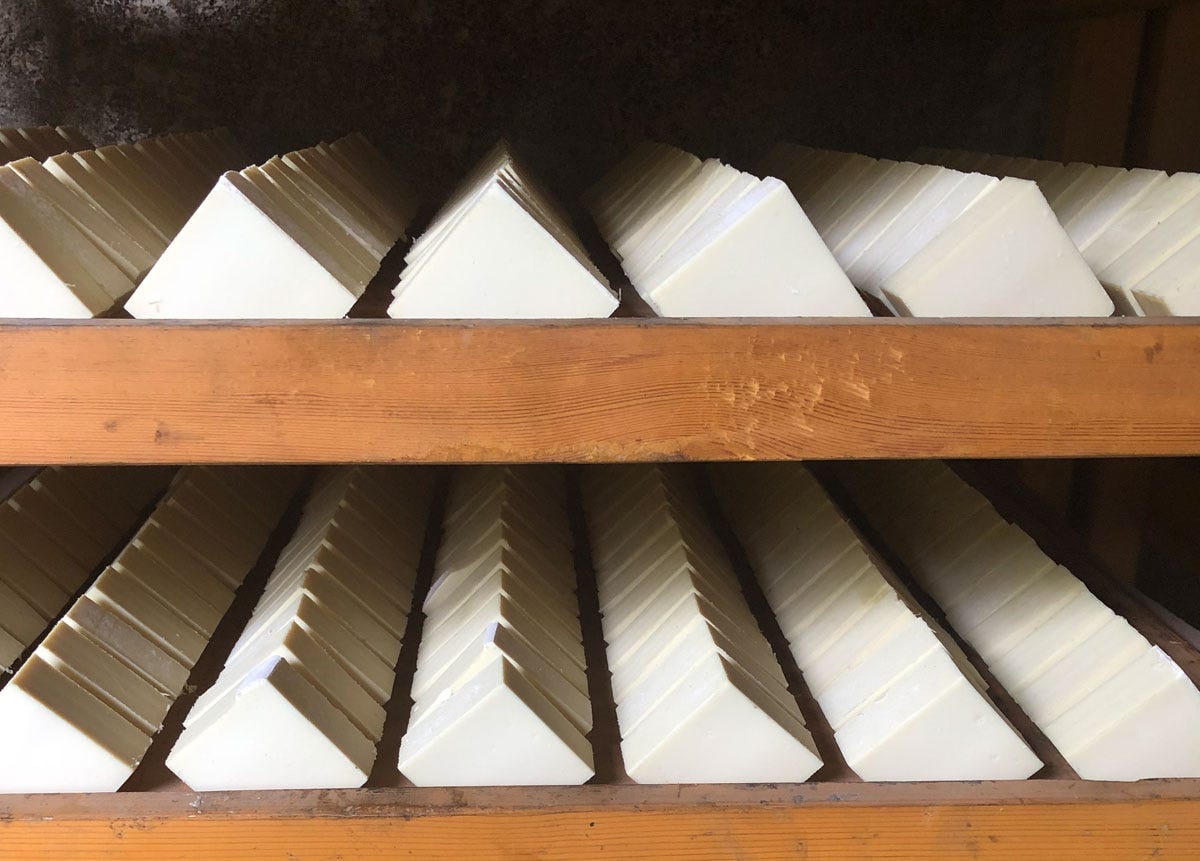
The traditional and highly photogenic way of drying the soap is to build these towers where the air flows freely around every side of each cube. The towers are nevertheless taken down and rebuilt regularly with the soaps rotated, to ensure the drying is even…
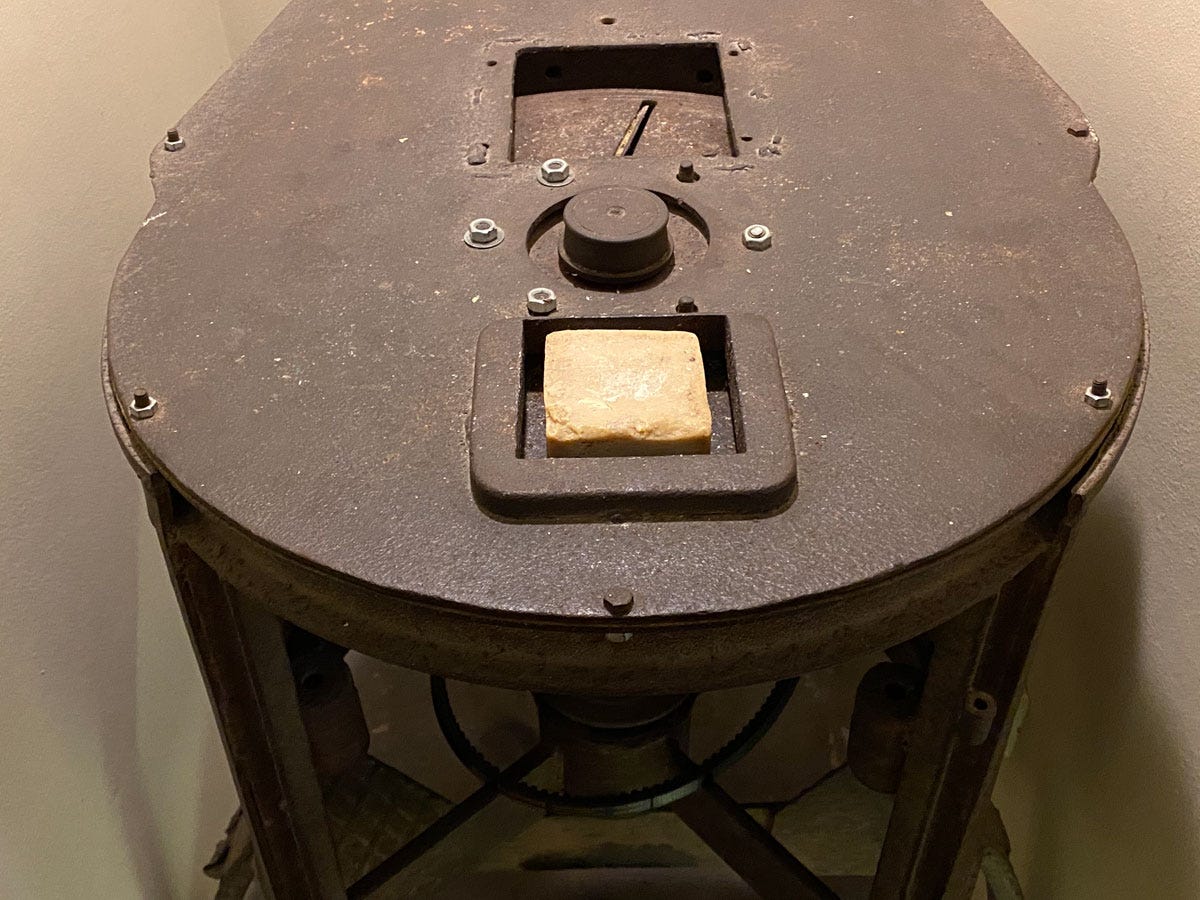
Once fully dry, each cube passes through the calibrating machine below. Inside the square opening is a rotating abrasive ribbon that evens out each side. The soap shavings are not wasted, but find a number of uses such as laundry detergent or being tied inside pouches to be placed in linen cupboards (for the smell and to deter moths6).
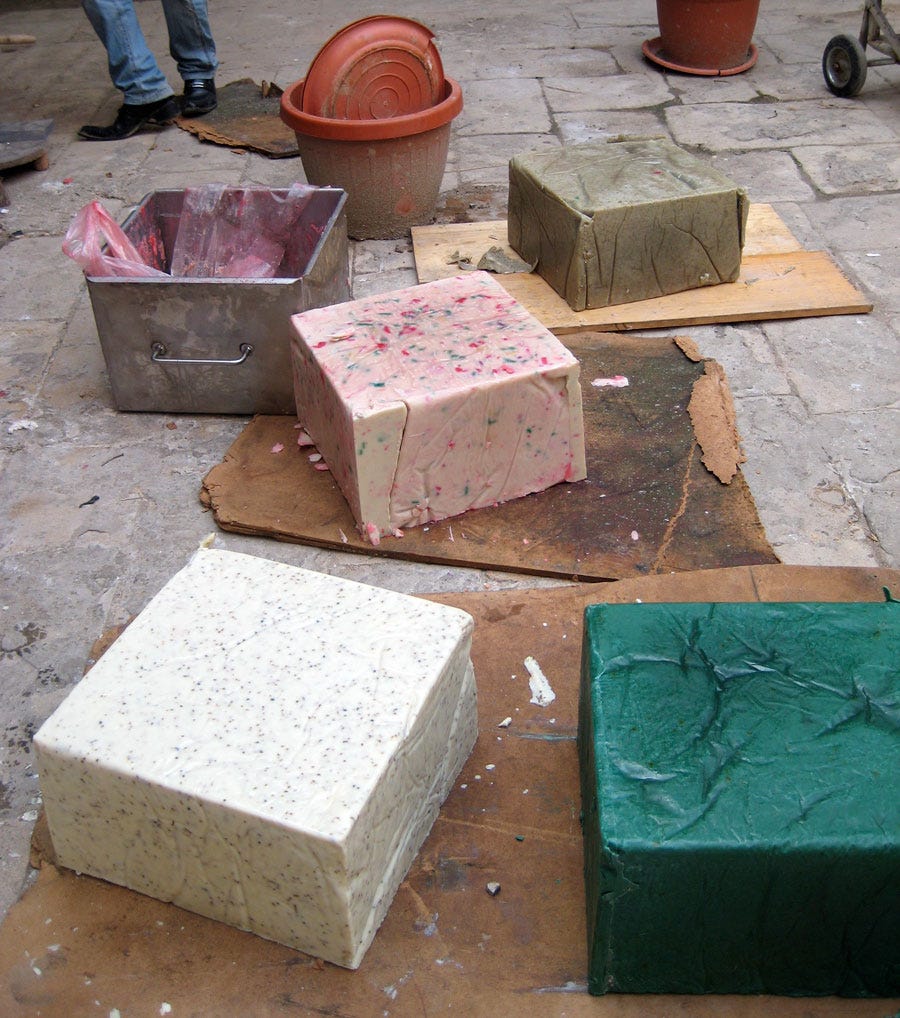
For smaller soapmakers that don’t have a cutting area, or for home production, there are other ways of making soap bars, for instance by pouring it in large tubs to make big blocks of soap, as was done below by a soapmaking family in Tripoli7 (random feet for scale).
Each of these blocks, while still moist and soft, is then cut into cubes by a more time-consuming process that is taking place below (apologies for the hand blocking the view): each block is pushed against a thin vertical wire that cuts it all the way through. A fixed metal plate serves as a guide to slide the block against. In this way each block is sliced, then each slice is cut into sticks, and finally each stick into cubes.
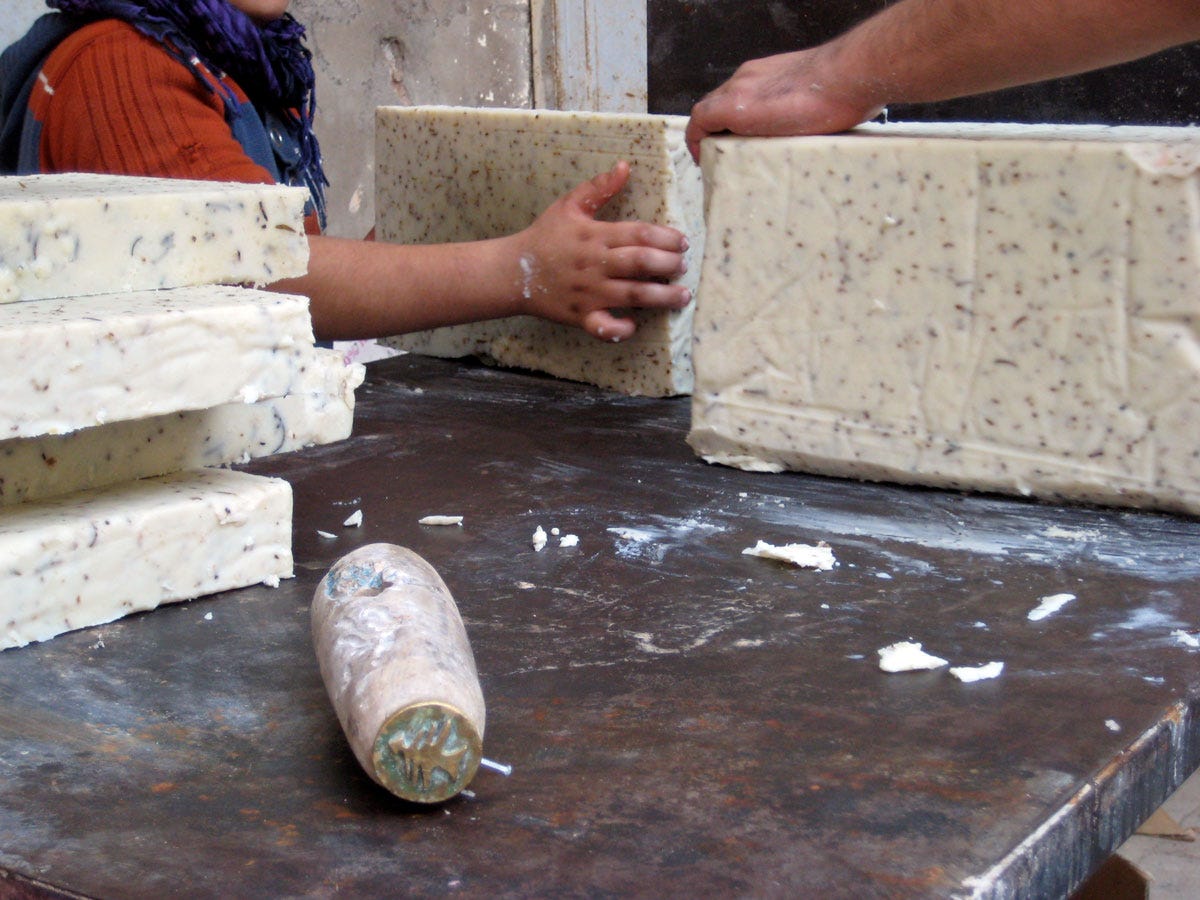
The stamp used here requires a mallet or firm slap with the hand, as demonstrated by the boss of the operation.
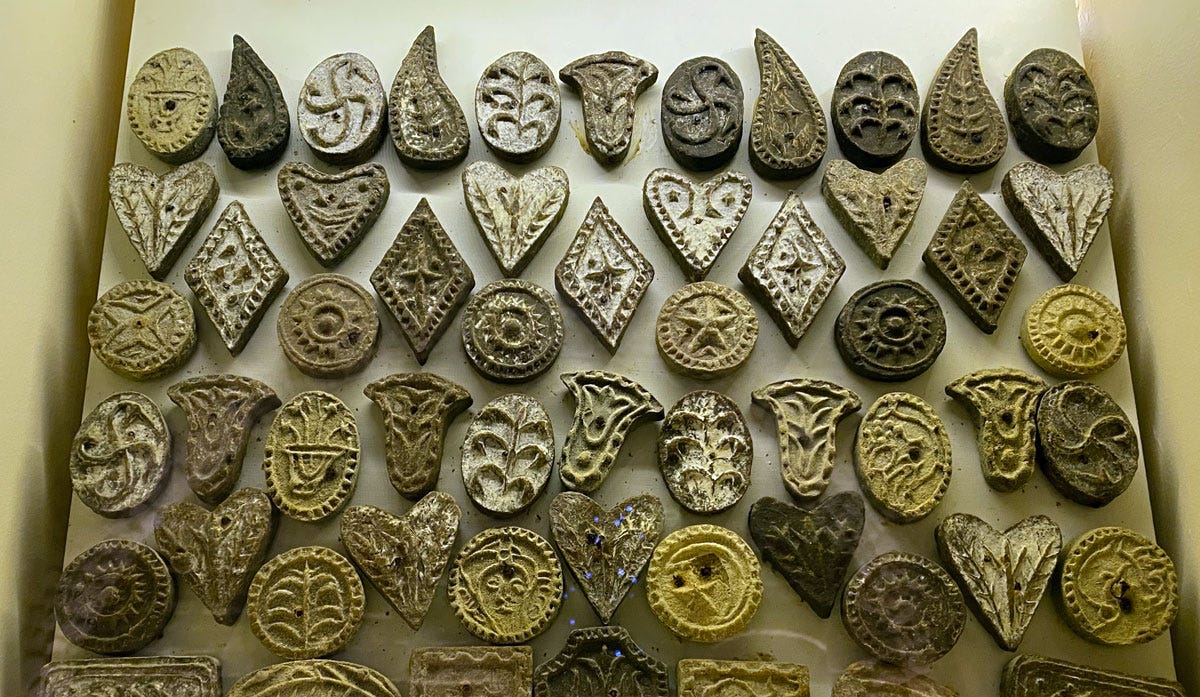
For an even smaller, domestic production, or to use up the shavings resulting from shaping the soap, the method used was to mix soap flakes or shavings with water to make a soft enough past to press into wooden moulds. Today these highly ornamental scented soaps are a production line of their own, as they make lovely gifts and are ideal for the guest bathroom, where a regular soap bar is no way to “honour the guest”.
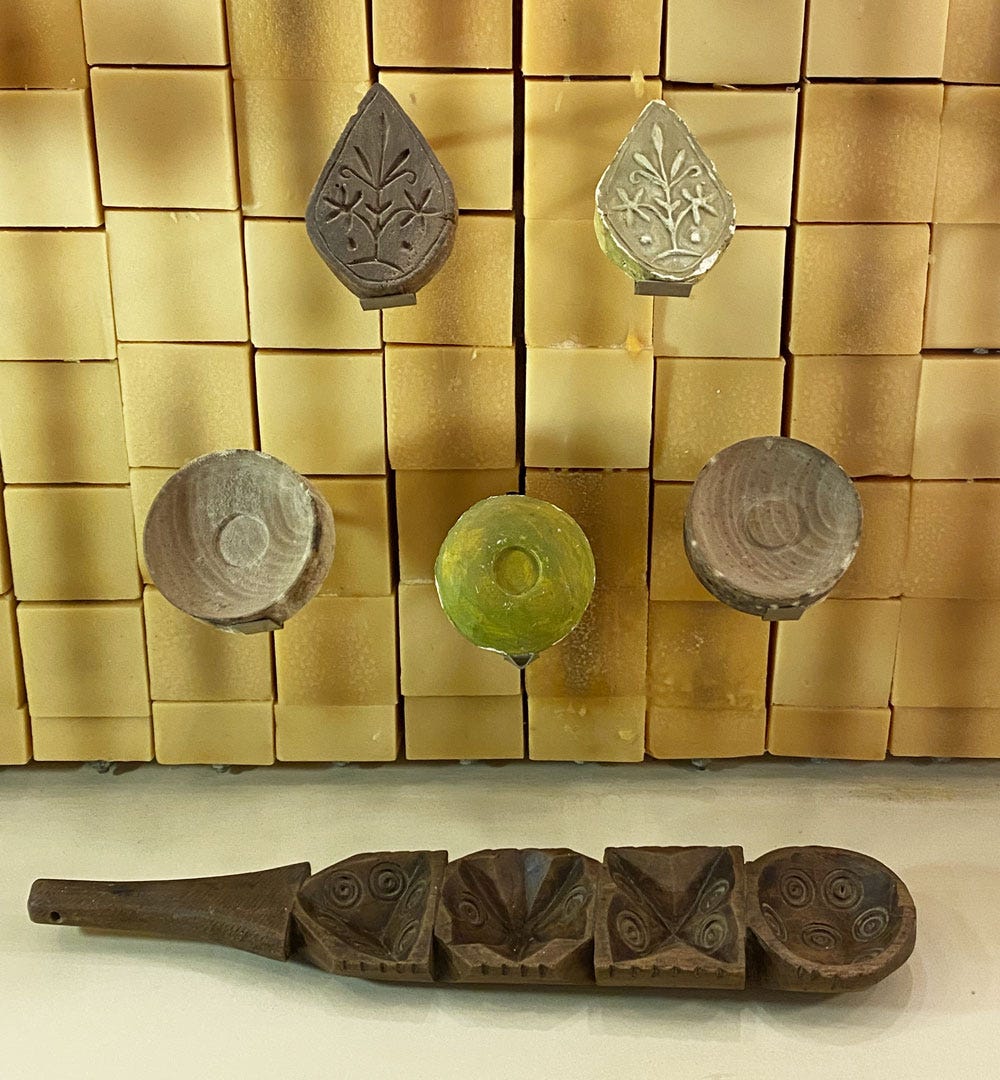
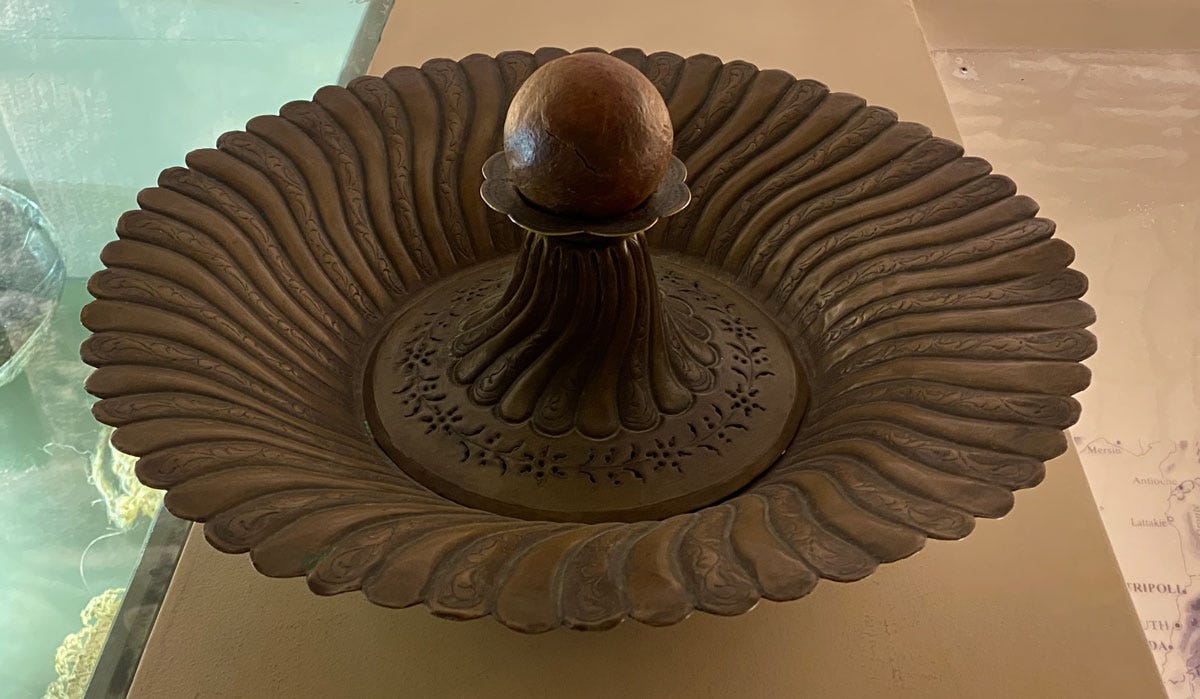
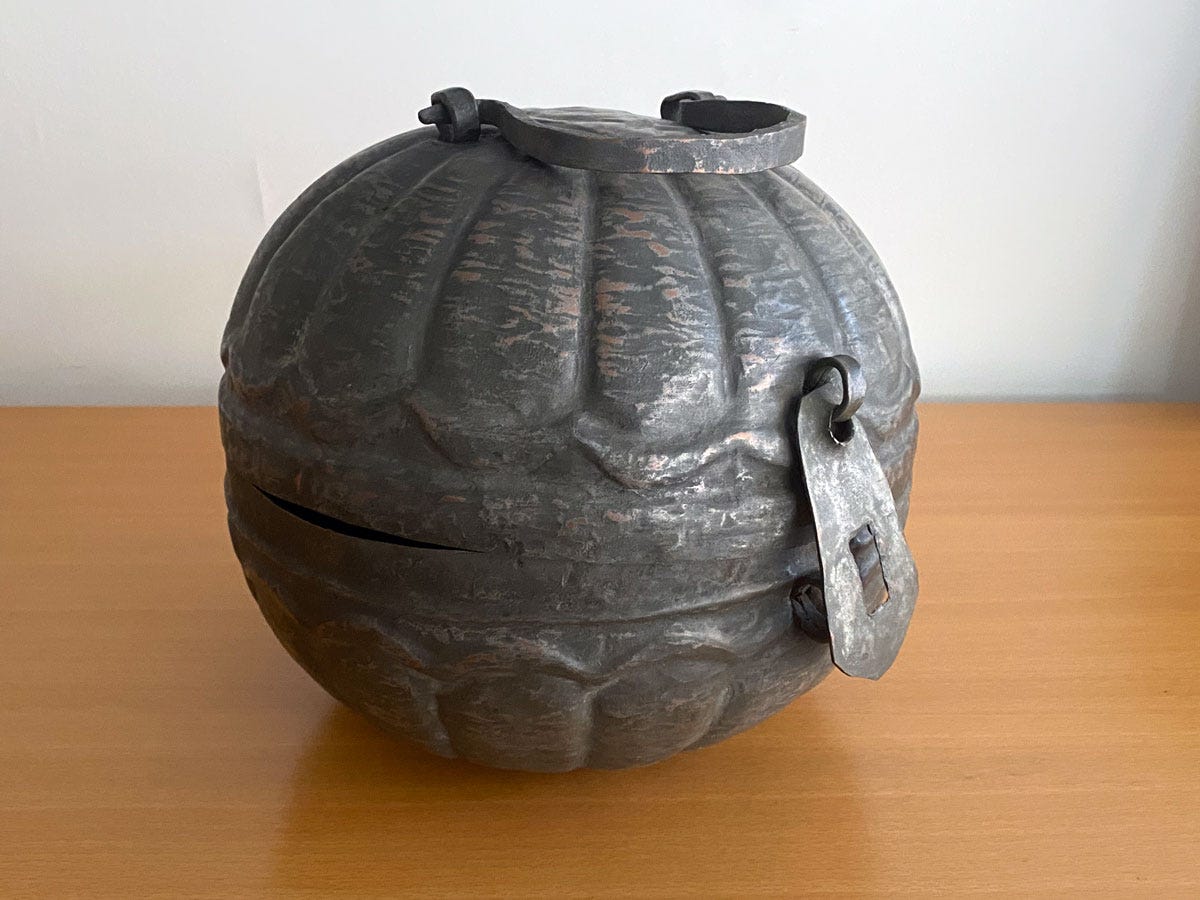
The special regard for guests is demonstrated by the nineteenth-century basin below. Before modern plumbing, the source of water was outside the house—but it wouldn’t do to make a guest go downstairs and out to wash their hands. Instead, such a basin was brought up to them, along with an ewer of water. The ball is a soap, made round by rotating it against a blade shaped like a round cookie-cutter, and the whole centre of the piece is lifted out to reveal a central bowl-like depression to pour the water into.
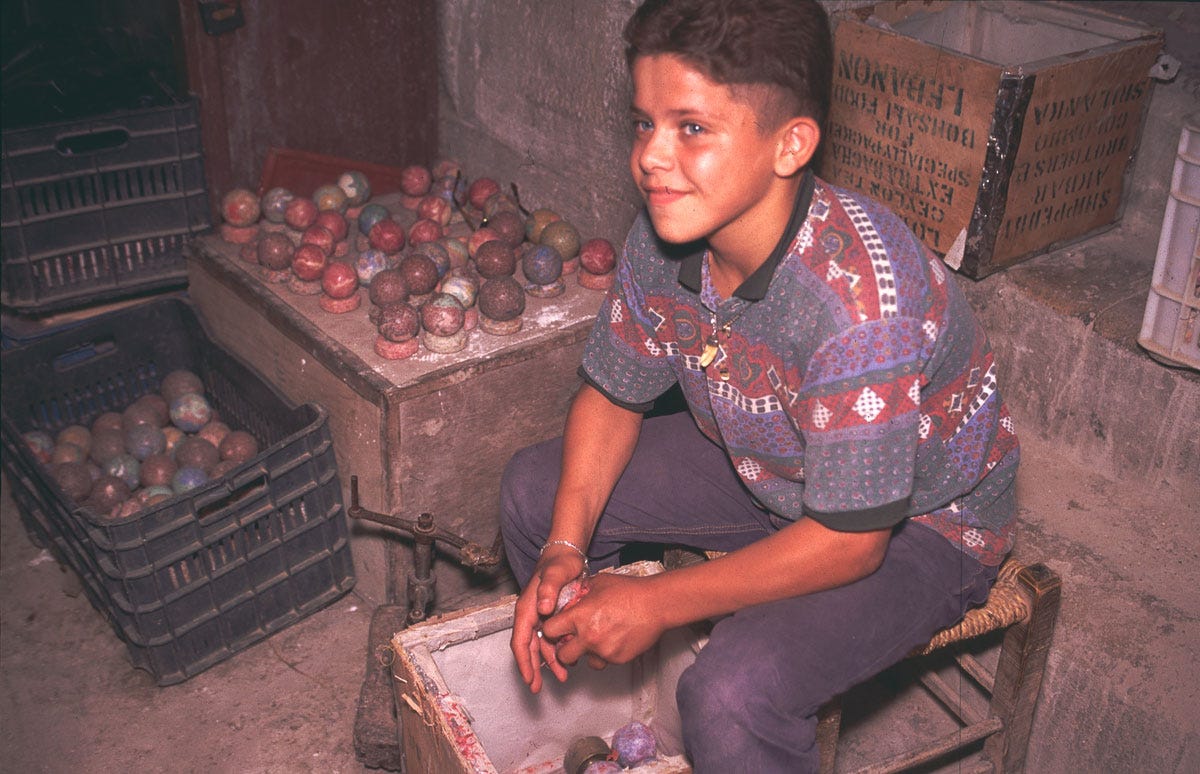
All this soap reflects the important place personal hygiene has always held in these societies – and in Islam, it’s a religious obligation – but in the absence of indoor plumbing or bathrooms, washing was a highly social experience. This brings us to the hammam, the communal bath.
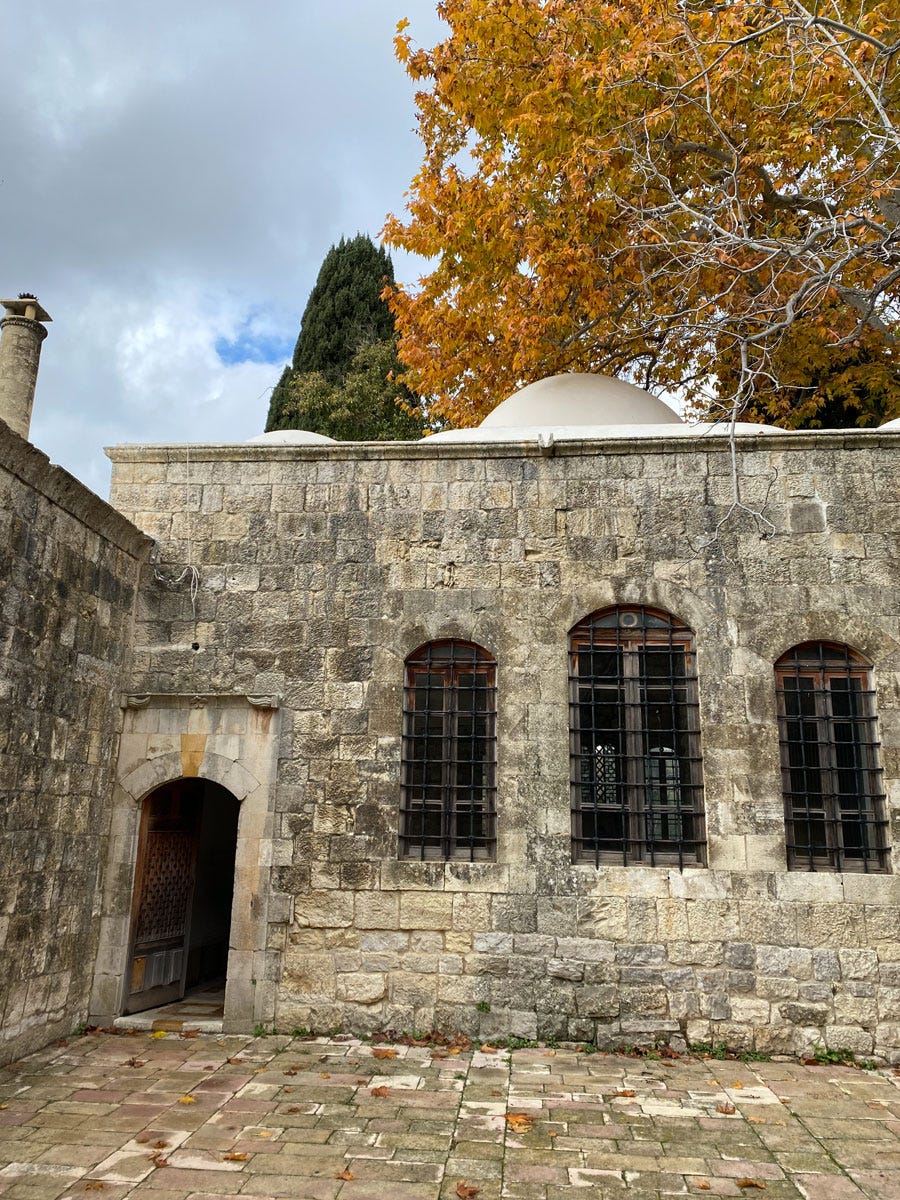
The hammam descends from the Byzantine baths and Roman thermae, and retains their organisation into hot, warm and cold rooms (caldarium, tepidarium, frigidarium). It’s open to men on some days and to women on others.
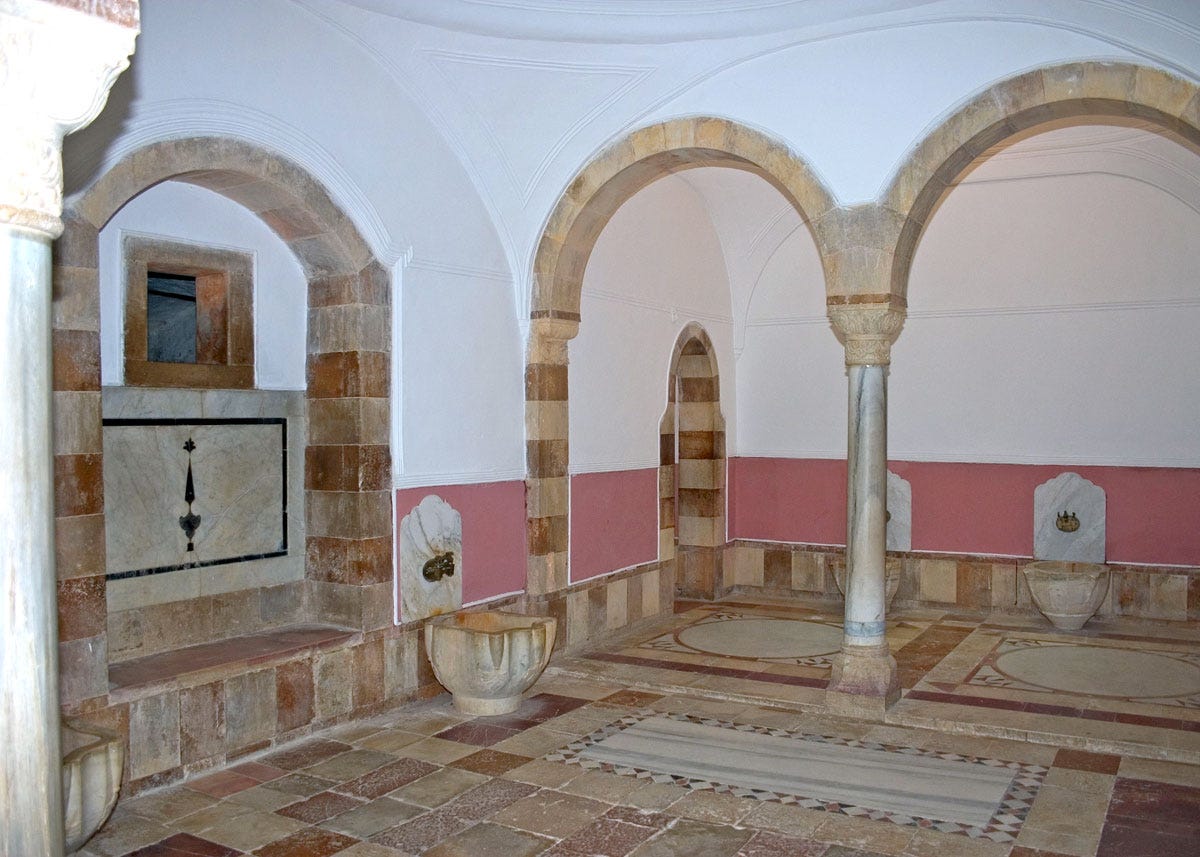
But first, an entrance lobby with a fountain and seating space…
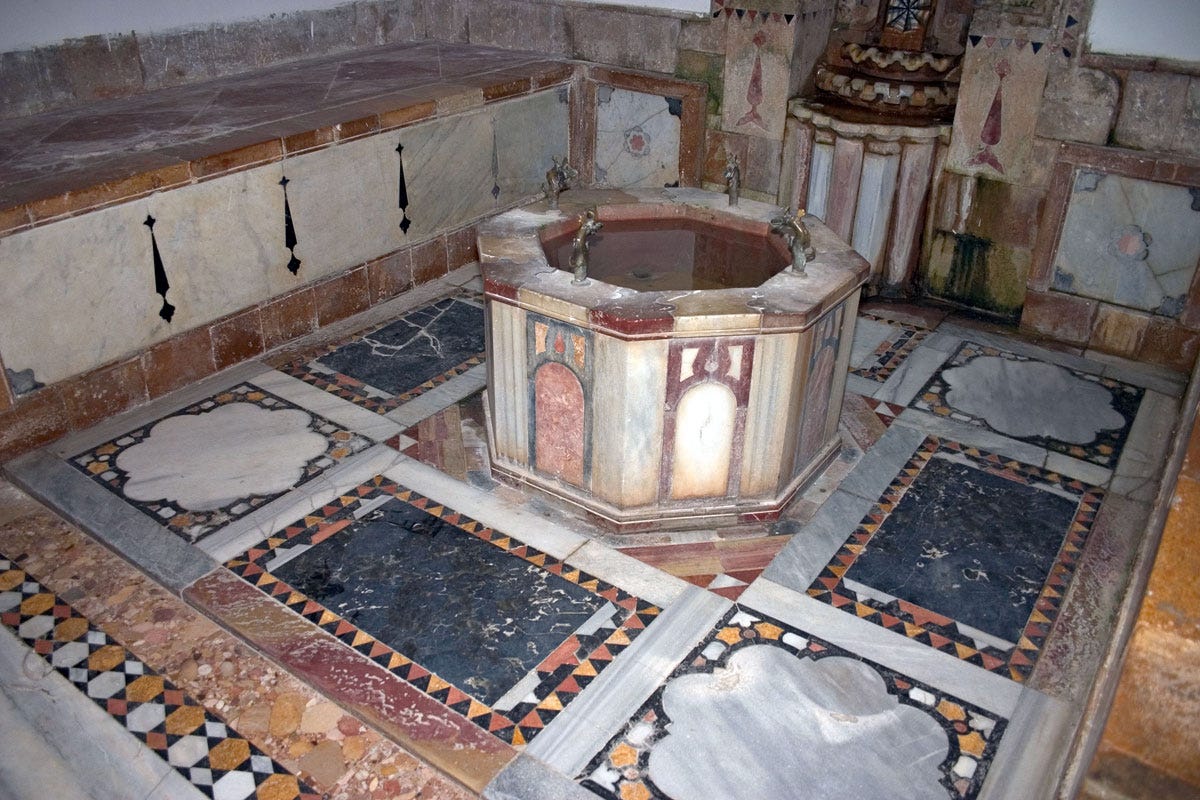
… where one could undress, change into bath clogs and grab a towel.
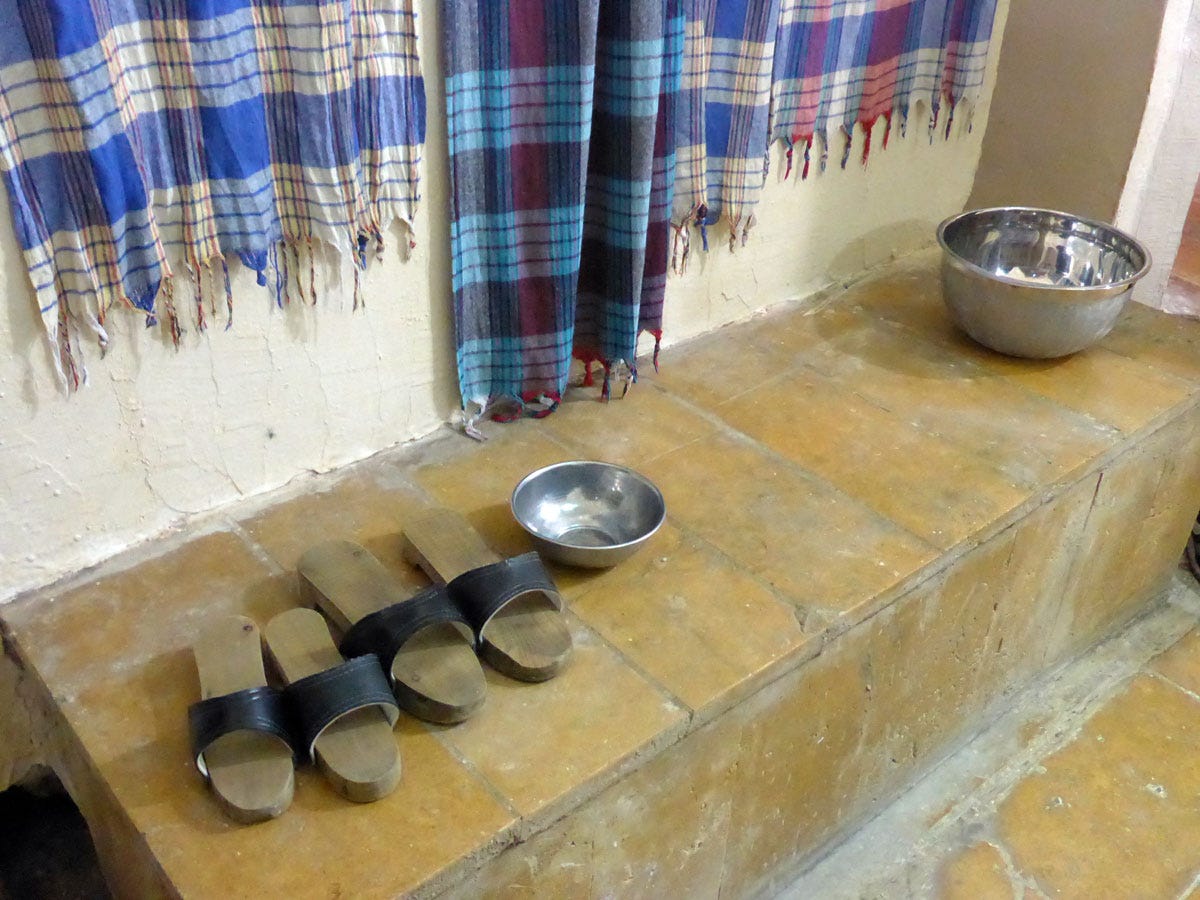
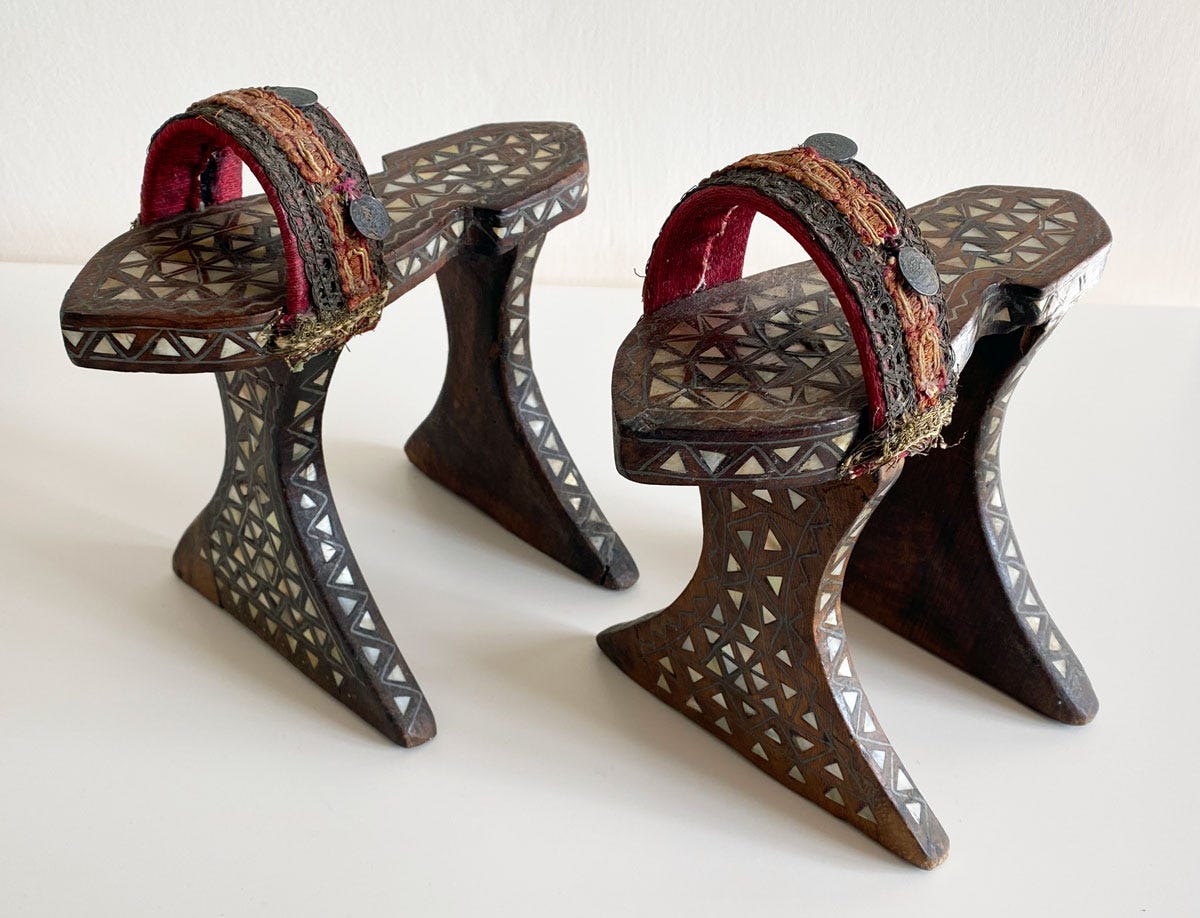
The clogs above are basic but high enough to keep one’s feet away from the wet floor. But in the heyday of communal baths, women’s qabqāb at least were famously high and ornate:
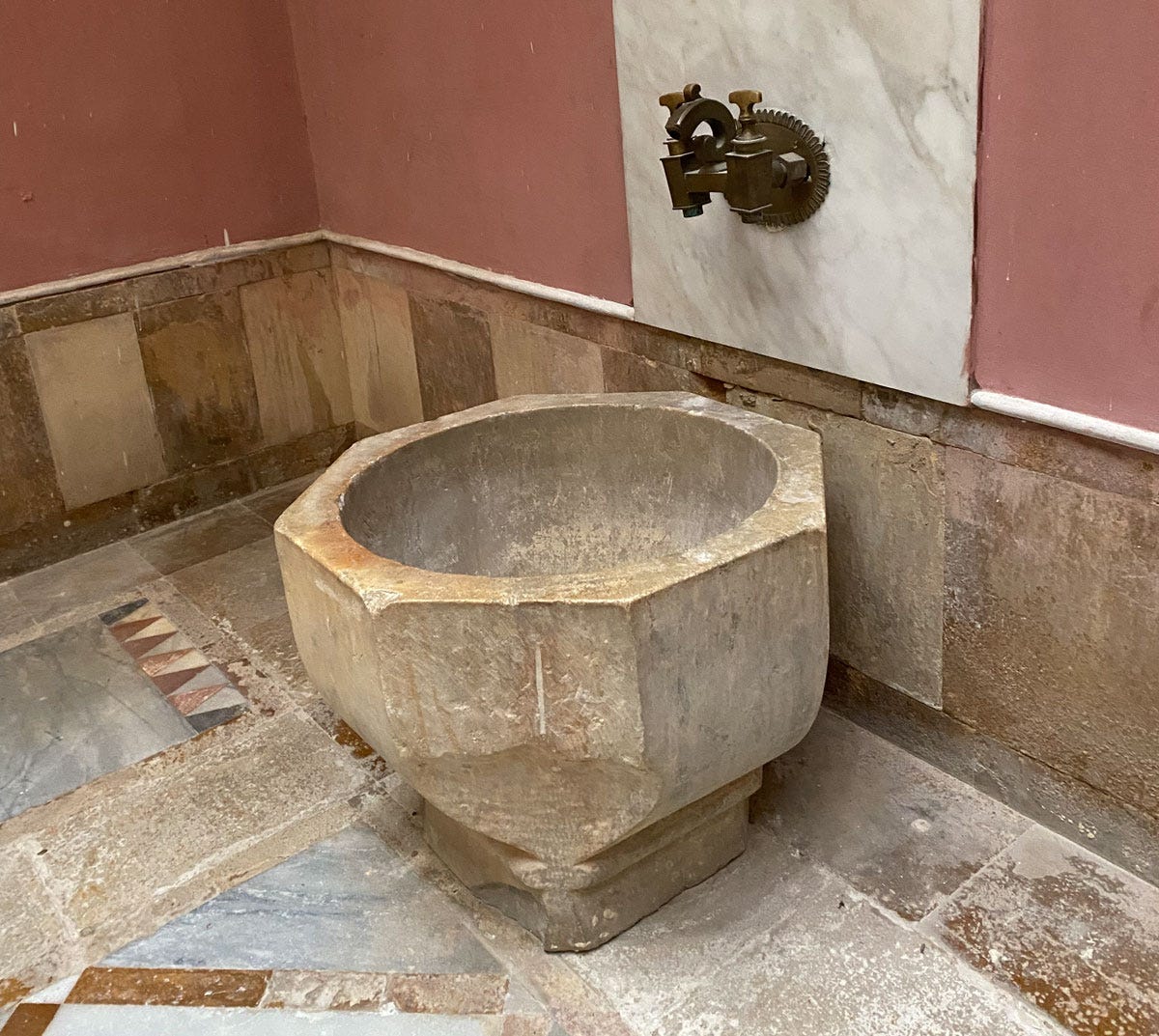
Along the walls in each room, these basins were for individual use. Using a stool and a ṭāseh or rinsing bowl, people could soap up and rinse off.8
A visit to the hammam, which wasn’t daily but at least weekly, was a complete self-care routine involving not just washing with soap, but getting scrubbed, massaged, oiled, hair cut, beard trimmed, by staff present for this purpose. In the cooler rooms food was served, patrons drank and smoked from water-pipes.
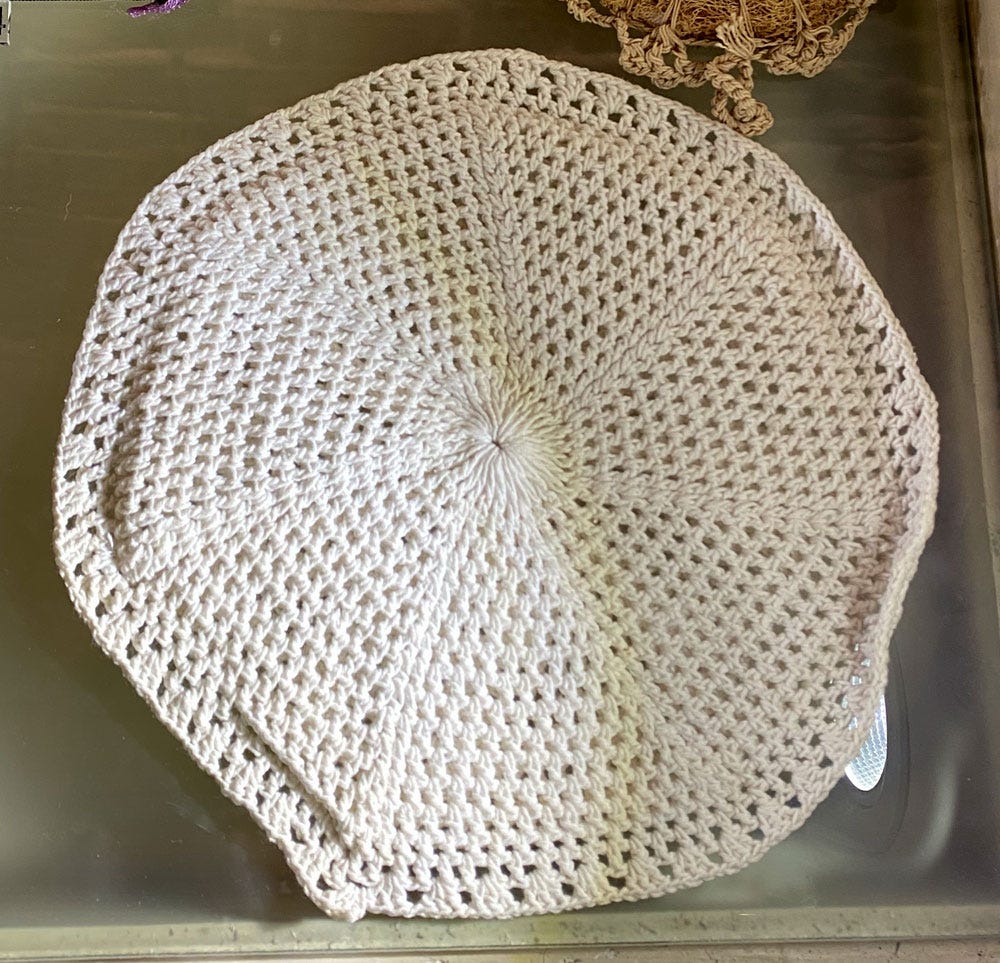
For women in particular, the hammam was the great socialising space, and also where mothers went looking for potential brides for their sons. The bi’jeh, a square of cloth into which clean towels and laundry were folded, was colour-coded to show relastionship status, thus cutting to the chase. It is also in the hammam that the bride would spend her wedding day, partying with her friends as she was given the full spa and beauty treatment for the ceremony. Men had more options to meet up (coffee houses have been the rage since the 15th-16th centuries) but the hammam was still a good place to discuss politics or sensitive matters, thanks to the sound of water keeping conversations private.
Indoor plumbing and private bathrooms brought this way of life to an abrupt end, but some hammams still operate, and as long as there will be olive trees, the soap will go on.
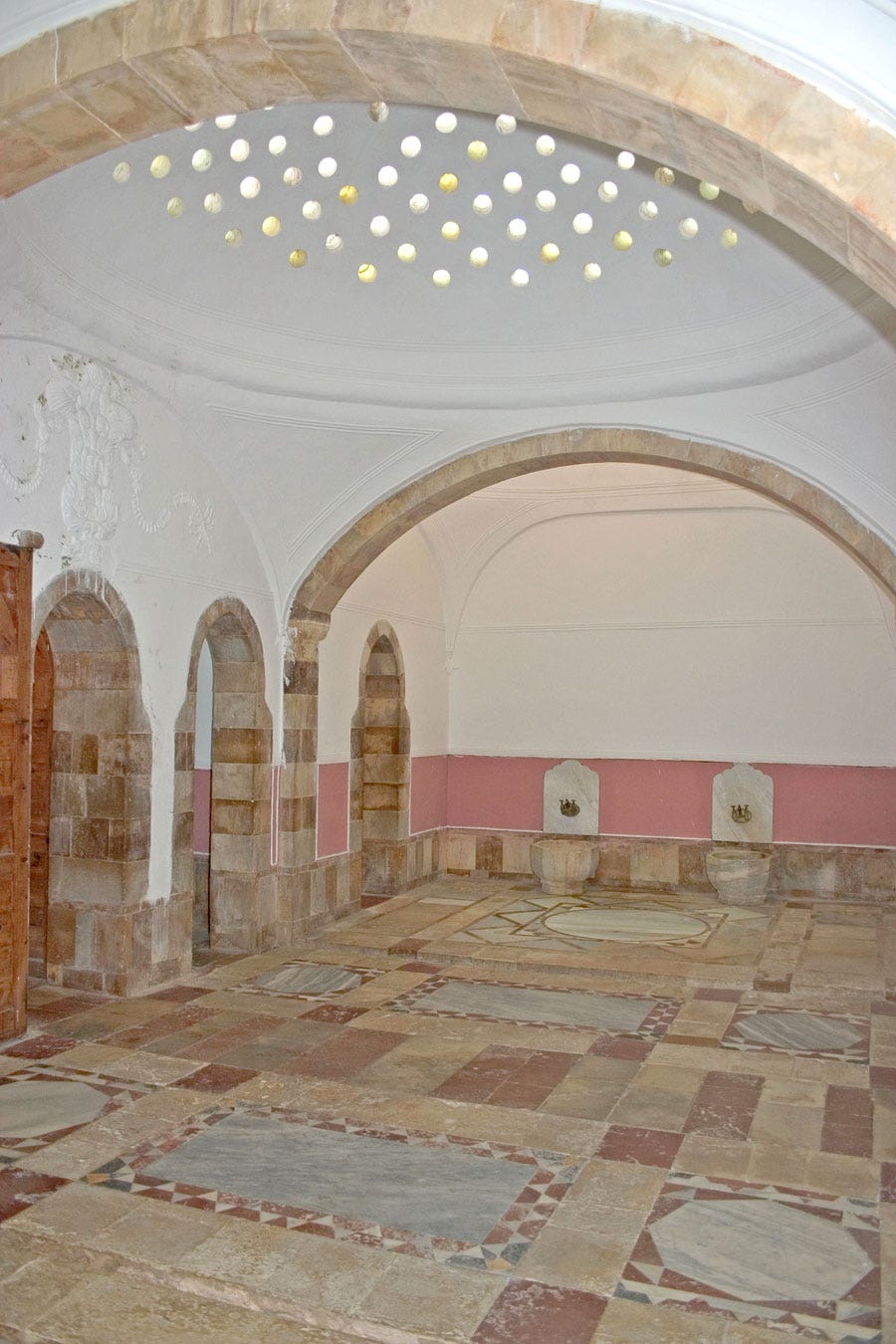
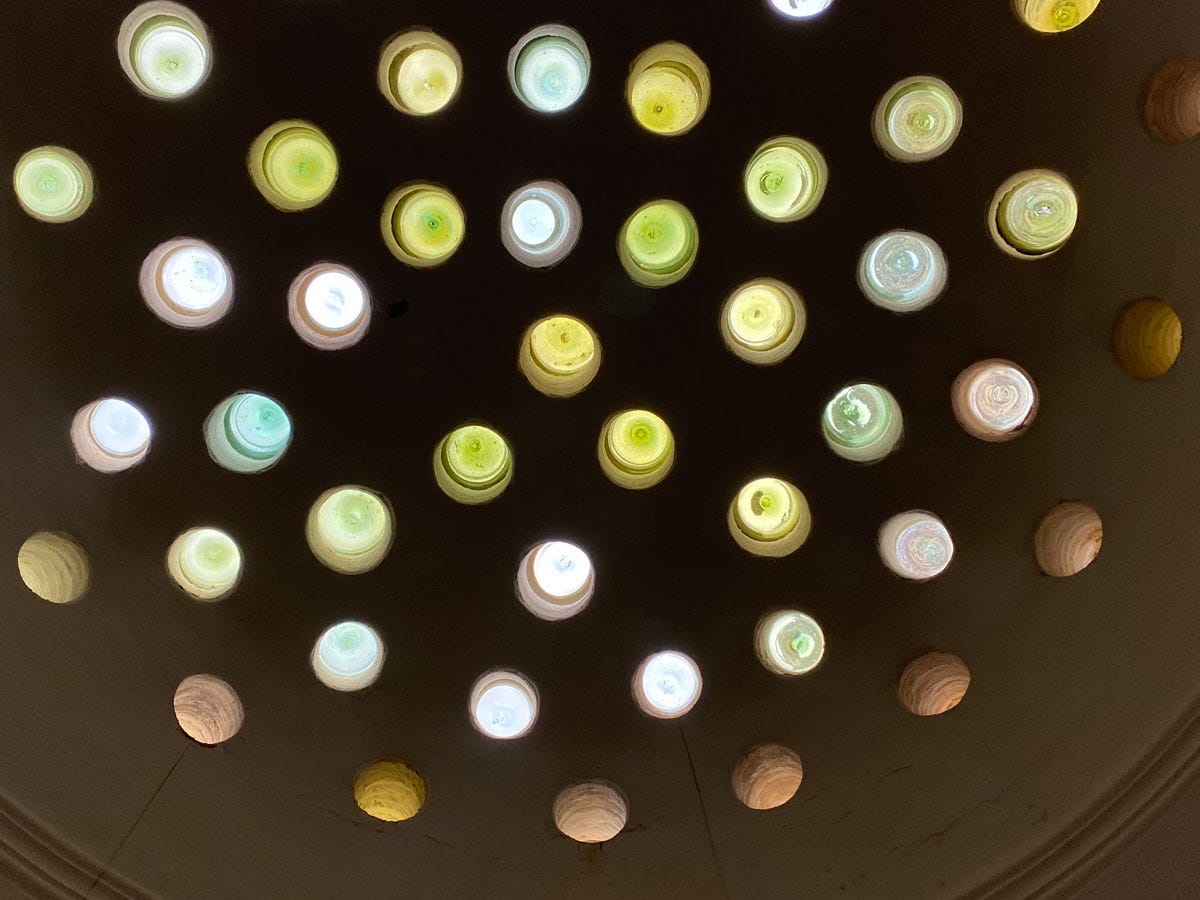
I’ll end with this characteristic, light-letting feature of the hammam: a dome pierced with a pattern of round holes, each sealed with glass that is often colourful. Every bath has its signature dome, even going back to Andalusian Spain…


We authored a children’s book on this topic together as part of our Lebanese Heritage series.
Forms we’re no longer familiar with include the handwashing preparations called ushnān (after the main ingredient which is potash). They presented themselves as a kind of powder to wash the hands with after a meal, but were also used to wash the mouth and freshen the breath. Here’s a description of one of these, from Nawal Nasrallah’s edition of the thirteenth-century "Best of Delectable Foods and Dishes”:
Take [90 grams] bunk (indeterminate ingredient); also take dried melon peels, 11 dried peels of apples and citrons, dried marjoram, and dry storax resin—[45 grams] of each—cyperus, sandalwood, sweet costus, and shelled maḥlab—[18 grams] of each—mace, black cardamom, cubeb, cloves, and aloeswood—[9 grams] of each—and [4½ grams] camphor.
Pound all the ingredients [but not the camphor], sift them, knead them with high-quality red wine, and shape them into a disc. Let it dry in a shaded place and then crush it on a wide stone slab with a muller, adding [9 grams] high-quality sukk (aromatic pastilles). Once you are done with this, infuse the mix with camphor; you may also add a bit of musk. It is splendid for the mouth and gums, and tastes good as well, God Almighty willing.
The same Al-Razi (aka Rhazes) who wrote the inkmaking treatise Zinat al-Kataba. A man of superlative scientific abilities, one of the most important figures in the history of medecine, he clearly had wide-ranging interests as he also wrote a treatise on chess in his spare time.
Saponification: turning a fatty substance into soap using an alkaline agent.
A resin from the bark of Liquidambar orientalis, not to be confused with benzoin (which comes from the bark of trees in the genus Styrax).
I can’t promise it’s much of a moth deterrent. I wish!
Lebanon’s northernmost and second largest city.
Though today most of us have never been to a hammam, we still use the idiom: Ḍa’et et-ṭāseh! “The rinsing bowl’s gone missing!” to describe a situation of confusion and chaos.
You know, the cord-snapping technique for getting straight lines over a long distance, is so simple and robust, that it's used regularly in construction, though it's not known by a lot of people who've never done any. Any hardware store will sell you a chalk-line reel, with a crank that reels a loosely twisted string back into a container you've filled with colored chalk powder. You then attach the hook on the end of the string at one end of the line you need, walk to the other end, and even with just one person snapping near the end you can get a near-enough straight line over a great distance, marked in a reasonably temporary way on any sort of surface.
Thank you for sharing! It is always very interesting to read about your research. I remember seeing old baths at Buddhist temples in Japan. Japanese bathing traditions are said to have started when Buddhism arrived. We don’t have olives, so it seems that soy-based soap was used.
Your photos look great. As a printmaker, I always find multiples very attractive!