

Earthly Time
The monthly labours of Medieval Europe

I recommend opening this article in a browser so you can click on the images to better see the details.
While de-cluttering my computer I rediscovered hundreds of details from medieval manuscripts which I documented for my research a couple of years ago. Among them are the delightful miniatures of activities associated with each month of the year, typically found in the calendar section of psalters. I shared a mere glimpse of them in the description of my artist book Circles of Time, but they’re worth a proper exposé.
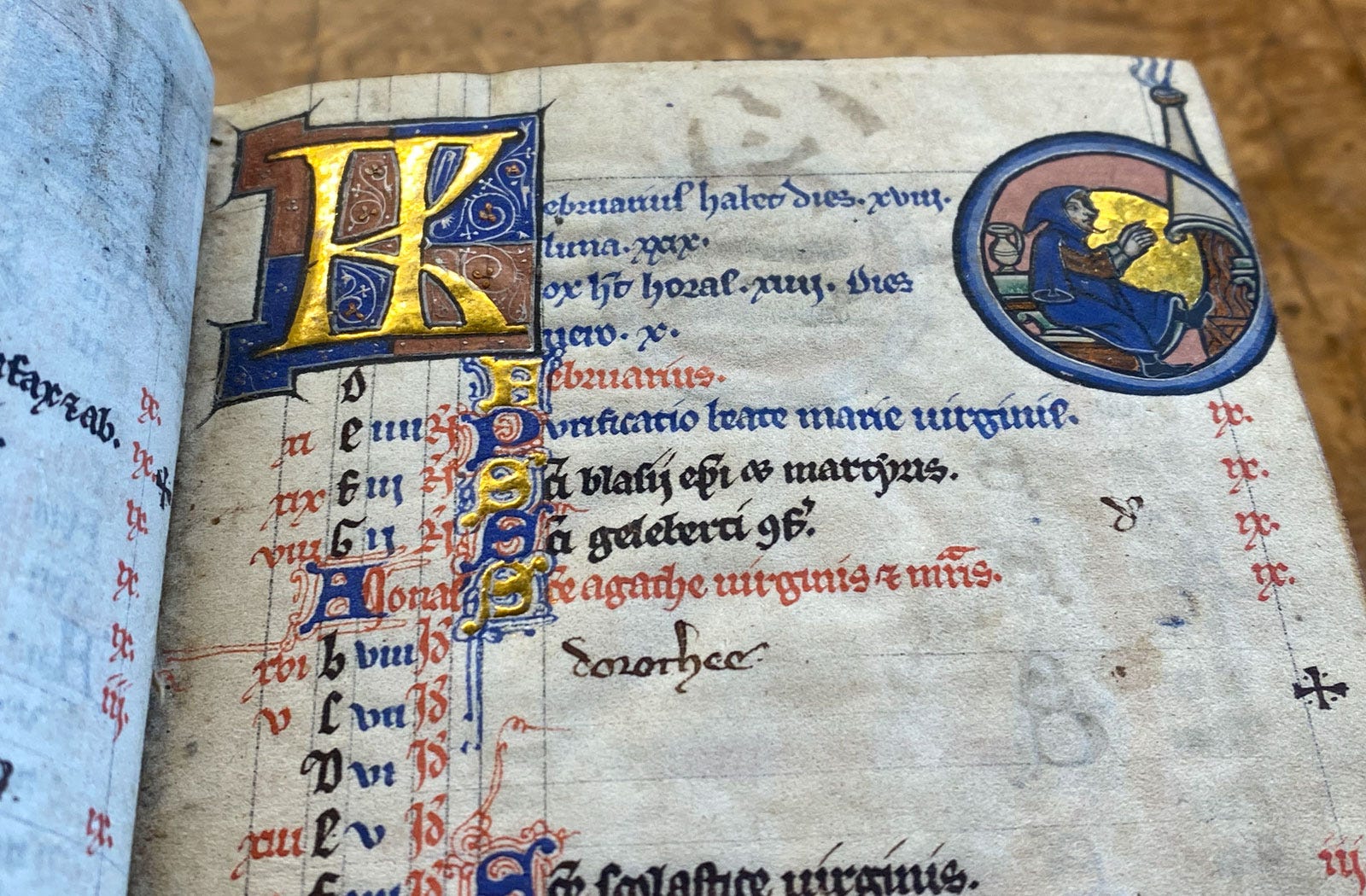
The pictorial tradition of the “Labours of the Months” was inherited from the Roman world: it emerged in late Antiquity, flourished in medieval Europe, and was still going strong when that era was drawing to a close in the sixteenth century. Each month is represented by a typical task in the year-long labour of producing food. These occupations can vary a little, or occur earlier or later from calendar to calendar, but overall are comfortingly predictable, which is what an agricultural year should be. They underline Medieval society’s understanding that the steady, predictable yearly cycle was God’s well-ordered design. They may also function as an invocative prayer for this cycle not to be upset by war, drought or disease. Any disruption was life-threatening, in a way our globally connected industrial societies can no longer imagine. Yet even in our time the food-producing tasks themselves have not changed. They may now be largely mechanised in many places, and many societies may be very removed from them, but nevertheless, until the unlikely day humans replace real food with synthesized nutrition pills, our ongoing survival still relies on the same tasks.
The illuminators responsible for these images drew on a small conventional set of subject matter, where there was little variation considering the vastly larger number of tasks the medieval peasant was busy way. This doesn’t get in the way of creativity, as the way to depict those conventional subjects was very much left to the artist, as we will see. These occupations depicted show signs of their Mediterranean origin, for instance in the focus on growing grapes and wheat; the importance of wine and bread to the Christian liturgy was probably a factor in enshrining these two products in the iconography at the expense of the many other crops that were properly staples of life in Western Europe at the time. The images also idealise the work and the life of the peasantry, which was very hard and full of uncertainty. Winter, for instance, was a hateful, feared time, a yearly test of survival, but you wouldn’t guess it from the cheerful figures used for January and February.
However, this post is not meant to focus on the history and context around the creation of the Labours of the Months pictures. For a deeper dive into that, there are recommended reads at the end of this post. What I’m interested in here is to look closely, with side-by-side comparisons, at the artwork itself, which for being minute is nonetheless detailed, expressive, and often humorous.
The images below, which are my own photos, come from four psalters in the Bodleian Libraries that I examined for my research:
A: MS Auct. D. 4. 3, made in England in the 13th century.
B: MS Douce 24, made in French Flanders ca. 1300.
C: MS Douce 48, made in France (date unclear).
D: MS Add. A.46, made in Liège, Flanders, sometime between 1250 and 1275.
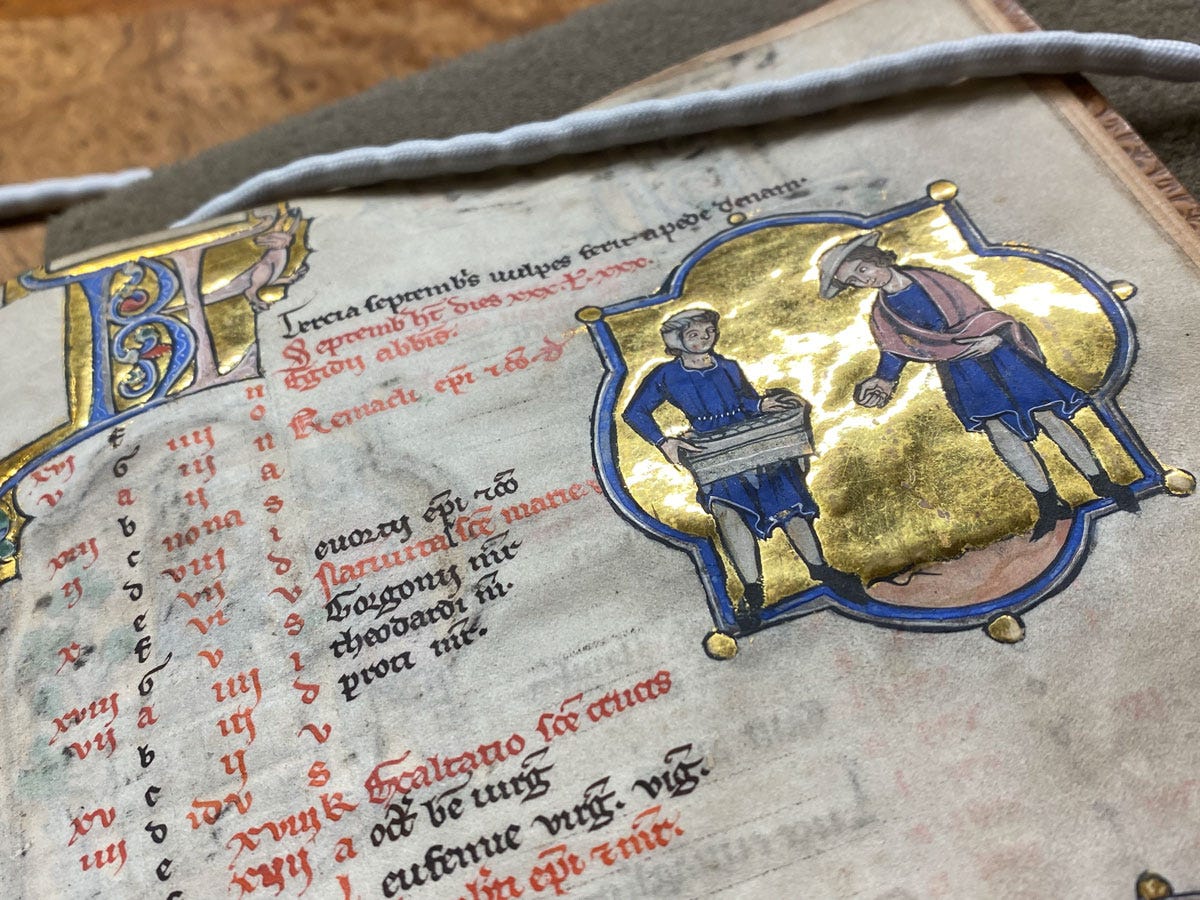
One more thing to mention. The philosopher Paul Ricœur defined the calendar as a bridge between cosmic time and time as lived by each individual, thereby creating social time (paraphrased). This is in evidence here, where the Labours express the Earth’s seasonal time, which impacts all earthly creatures and entirely shaped the lives of people until the industrial period. But cosmic time is also often included in the form of a second vignette depicting the Zodiac1 sign that comes in within each month. C and D include the signs so I will be sharing those, too.
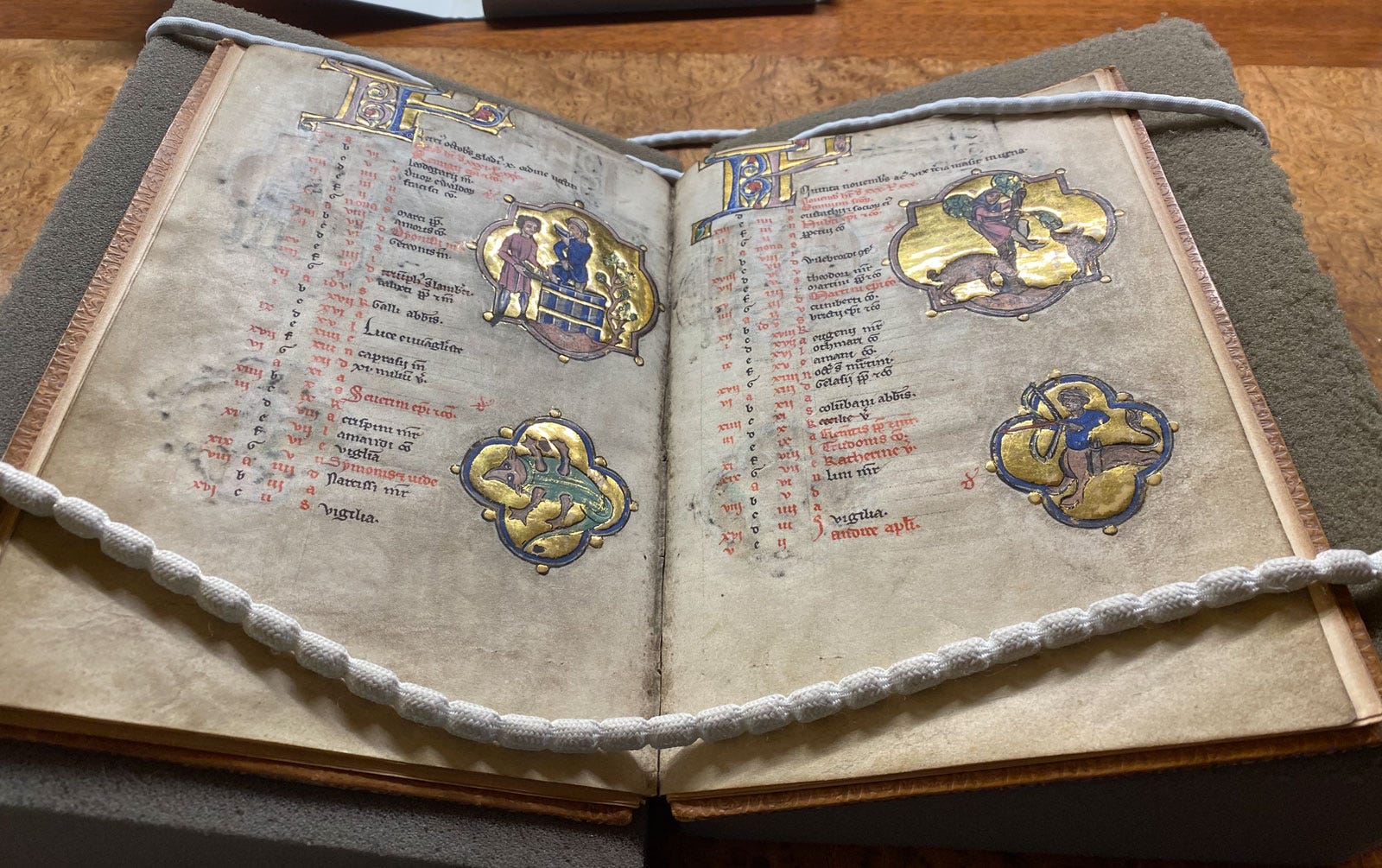
January: Feasting
In the dead of winter, there is no work to be done on the land. Most of the year’s work has been precisely to produce enough food to get through the Hungry Gap, and this is the time to stay indoors and consume those winter preserves. For some, it’s also the time to elcome in the New Year with a feast.


The revelers of B and C are janiform: one face looking back at the previous year, another looking forward to the coming one. Right at the onset, the heavily Roman nature of the calendar is revealed, referencing the two-faced god of beginnings and transitions. The A figure (whose strange headdress intrigues me) may not have two faces but still holds up soup in one hand and a drinking horn in the other. All of them, however, wear a cloak or cape and headwear: it’s pretty cold even indoors!
As for D, it presents a delightful image, considering how harsh the reality must have been: a warmly dressed and hooded figure, seated in the foreground of a richly stocked larder and laid table, warming his feet by the fire while clearly enjoying a bowl of soup.
January introduces the sign of Aquarius, so our calendar begins with this sign. This may not feel quite right, and there’s a reason for this…


While the Roman world set the beginning of the year on January 1st (to follow the Winter Solstice when the day is shortest), an older tradition was still going strong, that of beginning the year after the Spring Equinox. In other words, the year begins when life returns after the “death” of winter and the world is full of buds and newborn creatures again2. The Spring Equinox is of course when the Sun enters Aries, which is the sign we are used to seeing as the first of the twelve: the Zodiac remains rooted in this older reckoning (and so does our tax year).
February: Candlemas
February is not, in practice, different from January, and different artists have made different decisions regarding how to illustrate it without being repetitive. It does feature one special event: the feast of Candlemas, depicted in A and B by women holding tapers.


D on the other hand is rushing ahead a little, or maybe it’s on Mediterranean time, and shows a pruning operation that is more commonly seen in March. The pile of faggots could suggest he’s in need of more firewood, but that wood is awfully green and completely unsuitable for immediate use. The dog is depicted intensely watching his human up in a tree, and with slightly parted jaws, as if whimpering anxiously!


March: Pruning and Digging
Two images vie with each other for this month: pruning the vine (for which we can observe a variety of bladed tools being used), and turning the earth or digging ditches using a spade.


Behind the digger in D, a smaller figure holds a round object. They could be performing a part of the task unknown to me, but they look strikingly like a child with a ball3, pausing to watch their father work.


April: Gathering flowers
This month is defined by the delight in growth and blossoming, and this delight is completely ungendered. Both men and women are depicted gathering blossoms and making crowns of them, sometimes for the purpose of courtship, which may also be depicted.


The man in A has just placed a leafy crown on his head and looks joyfully pleased with the effect. Look at the expression on his face! The girl (?) in B seems to be doing a little happy dance. To underline the return of life after winter, C holds up not only a budding bough but also a nest with hatchlings.


May: Hawking
With remarkable unanimity, the May iconography shifts its focus on the nobility (psalters were after all commissioned by the gentry) and what is clearly the important pastime of falconry.


In A we see the training stage, while the others on horseback are actually hunting. I have nothing but sympathy for the artist of B, who had to fit all his figures in that narrow doorway format, and so found himself having to draw a horse head-on. The horses in C and D are simply splendid, and clearly a very familiar subject, moreso than the falcons themselves…


June: Reed-Cutting
Cutting reeds and carrying them away in bundles (A and B) is a frequent subject for this month’s iconography, but June shows a good deal of variety: here C is scything grass instead, and other calendars depict fruit-picking, thistle-cutting, or sheep-shearing.


While A shows unlikely cheerfulness, B is noticeably less happy and will get more grumpy as we go. The scythe in C is splendidly placed in the composition to continue the background circle of gold and preserve its concentricity with the frame. Note also the loin-girding! D seems to be gathering flowers rather than fruits. I’m not sure what for, but it was likely also food-oriented.


July: Hay-Making
The scythe is omnipresent this month as long grasses are cut and gathered for hay that will feed the farm animals in winter. But for some, the wheat harvest is beginning…


What did I say about B? This is clearly not fun work. D even has a jug of water hanging from a nearby tree, to take much-needed hydration breaks.


August: Reaping
The precious wheat harvest begins, using a small hand-scythe.


The man from A looks as goofily pleased as ever, while B clearly resents the back-breaking work. C is still running ahead and already threshing. The scene in D is particularly interesting as it shows both the peasant and his wife working at the harvest, with what I assume is an official standing over them threateningly with a cudgel. I could be wrong but by the way he’s pointing, I’m guessing he’s there to collect rent or taxes in the form of corn. A rare moment of unpleasantness in what is otherwise an idealised representation of reality.


September: Wine-making
Though my samples all show different tasks, September is usually associated with grapes: either picking them (A), or crushing them for wine (C).


Leaving the unhappy B man to his chore of threshing, C may be my favourite image of the lot. A man is treading grapes in the wine press, munching on some of the harvest as he works. His colleague, still loaded with the heavy basket of grapes he’s worked hard to pick, is protesting! In D, the order is reversed and what we see taking place here is the sowing of seeds.


October: Sowing
It’s time to prepare for next year’s harvest, and everyone is sowing, some out of a basket, some out of a bundle tied around their shoulders.


Everyone except D, who’s now busy with pressing the grapes in a humorous scene that echoes the previous one: the man in the press enjoys some fresh grape juice as he works, his colleague looking on grumpily, or perhaps with envy?


November: Acorn-shaking
In November oak trees are heavy with acorn, a food adored by swine, and so it is the month to shake them from the branches for feed. I have witnessed this in Andalusia where this is still practiced, and the happy faces of the pigs/boars shown below is not exaggeration. The only thing lacking are the grunts of delight.


Alas, as shown by B which is running a little ahead, there’s no such thing as a free lunch, and there’s a reason why the animals are fattened right now.


December: Slaughtering
The most common theme for the last month of the year is the killing of pigs or oxen, to cure the meat for winter; C even shows us the cooking pot for which the unwary pig is destined.


But another activity we see around then is baking bread, and B shows us the breadmaking oven. Occasionally, the feasting seen in January has already begun.


Summing up
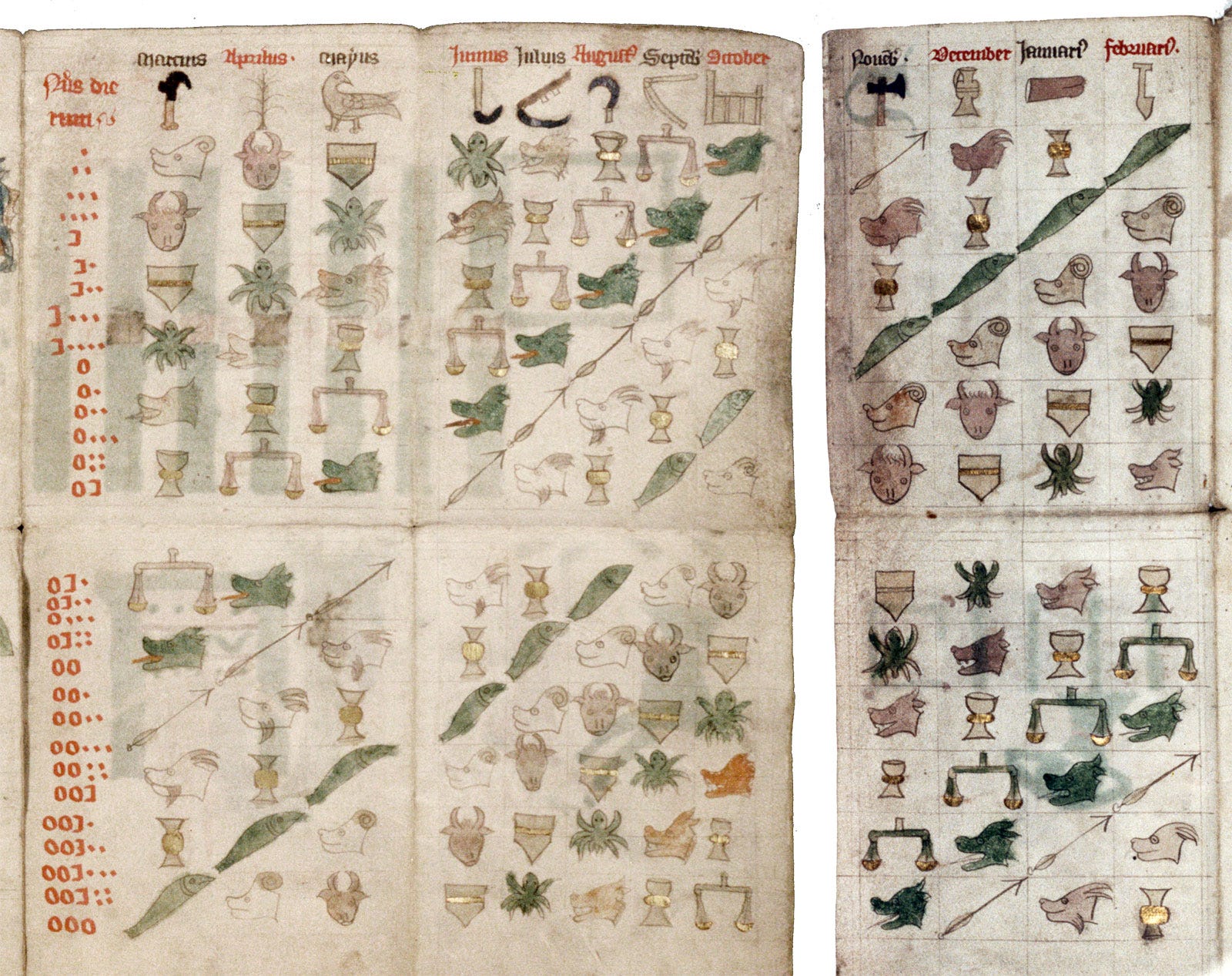
The Labours were so well established that in the table below, the months (first line) are indicated by a single implement or creature taken from the series above. I’ll leave you to figure them out, based on the images and description above. And yes, the year is here shown starting in March. (Below the first line, the symbols indicate signs of the Zodiac).
Recommended reading:
Henisch, Bridget Ann. The Medieval Calendar Year. Pennsylvania State University Press, 1999.
Hourihane, Colum, and Princeton University. Department of Art and Archaeology. Index of Christian Art. Time in the Medieval World : Occupations of the Months and Signs of the Zodiac in the Index of Christian Art. Dept. of Art & Archaeology, Princeton University, 2007.
Hill, David. “Eleventh Century Labours of the Months in Prose and Pictures.” Landscape History [Wakefield], vol. 20, no. 1, January 1998, pp. 29–39, https://doi.org/10.1080/01433768.1998.10594500.
More illustrated psalters to look through on Digital Bodleian:
MS. Douce 49 (Flanders, late 13th c.)
MS. Laud Lat. 84 (Flanders, late 13th-early 14th c.)
MS. Auct. D. 2. 6 (St Albans, 1140-50)
MS. Auct. D. inf. 2. 11 (France, 1440-1450)
MS. Rawl. Liturg. E. 14 (Flanders, ca. 1440)
As a reminder of what the Zodiac signs are: the ecliptic is the ring-shaped region of the sky, with the Earth at its centre, along which the Sun appears to travel throughout the year, returning to its starting point after 365.25 days. To map the course of the Sun, and therefore keep track of the year’s passing, this ring was divided into 12 equal sections. The dominant constellation in each of these sections is the basis for the Zodiac sign. The system would have been very neat with the months corresponding to the signs, if the calendar we used today hadn’t been shifted and modified several times since its establishment.
This is still the case in Iran: Nowruz, the New Year, falls on the Spring Equinox.
This would not be an anachronistic reading. From Wikipedia: “The first known use of the word ball in English in the sense of a globular body that is played with was in 1205 in Layamon's Brut, or Chronicle of Britain in the phrase, "Summe heo driuen balles wide ȝeond Þa feldes." ("Some of them drove balls far across the fields.")” – and this is just the mention of a ball in English in writing. The toy itself already had a long history.
Thanks for pointing out the expressions. I enjoyed noticing the shared humanity…